

Frequency
Where does your attention go, and what becomes possible when you choose where to direct it? Frequency explores the relationship between attention, intuition, creativity and the value we bring to others. An invitation to consider what we receive, how we operate and what we transmit into the world.
Your operational frequency influences the value of what you transmit.
- CG Excellence
What Are You Tuned Into?
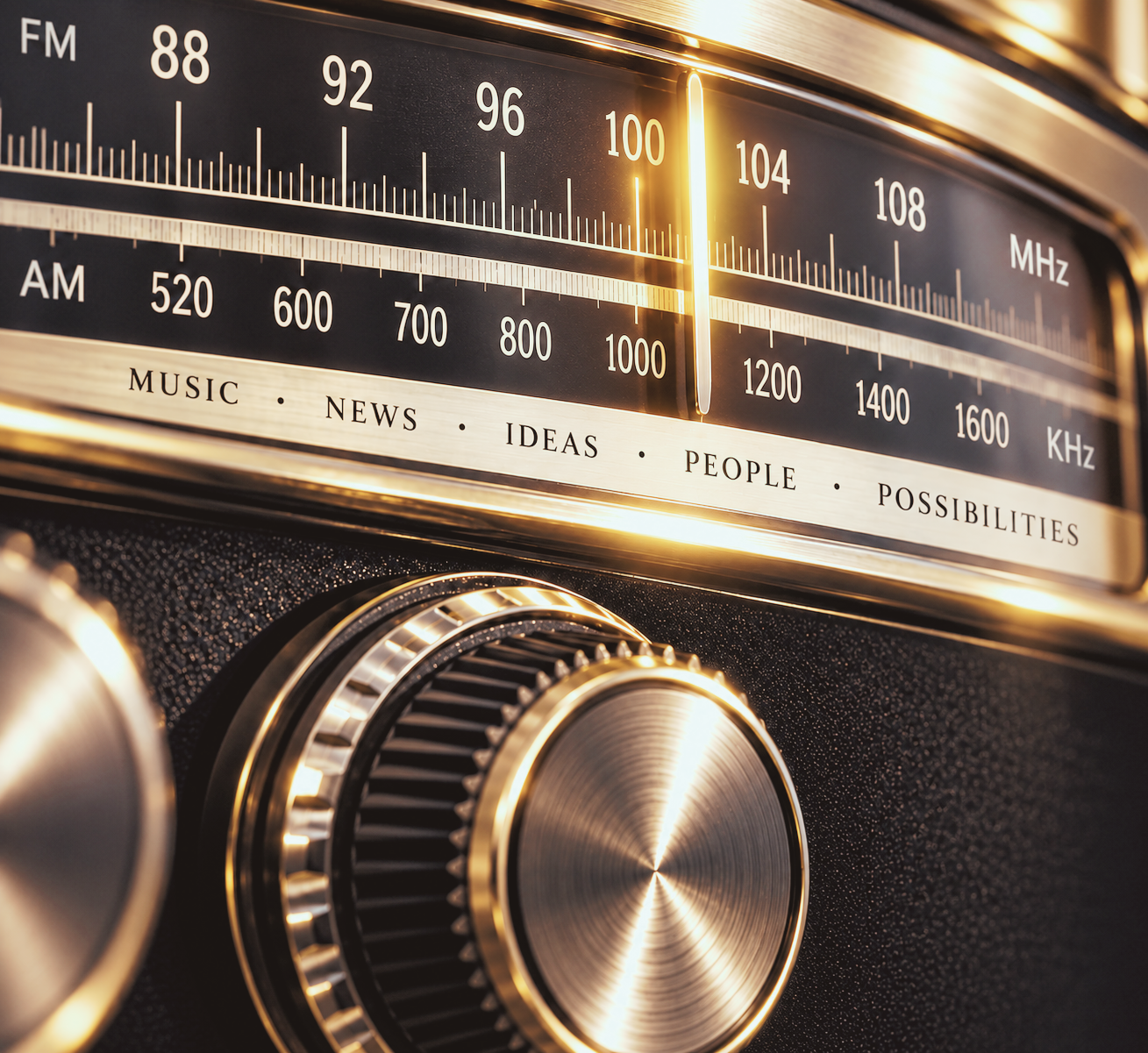
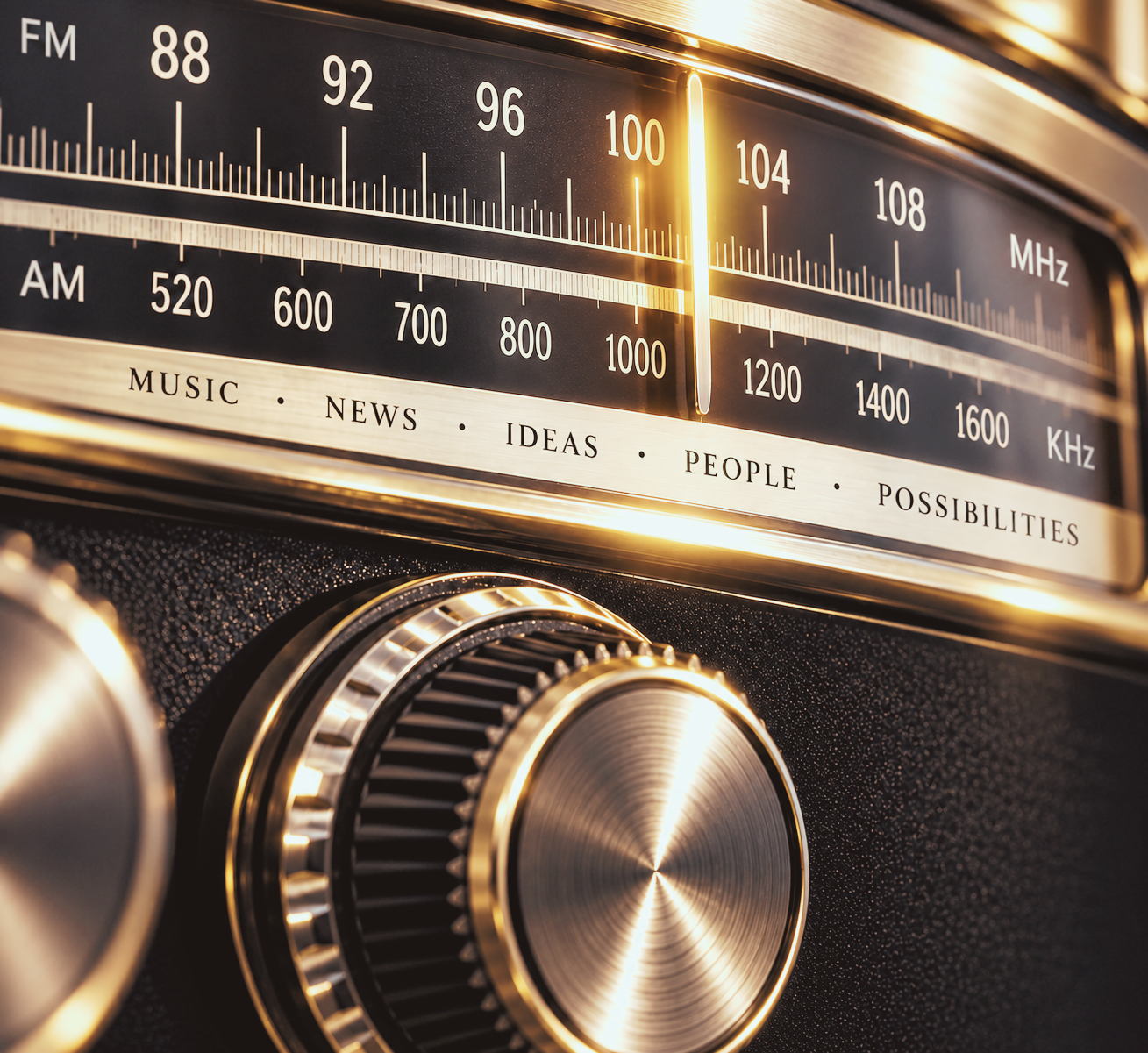
An old radio offers an interesting lesson.
Turn the dial and one voice disappears as another begins to emerge. Move a fraction farther and music replaces conversation. Between stations there may be static, fragments and interference until suddenly the signal becomes clear.
The other broadcasts continue.
We simply tune into something else.
Perhaps our attention works in a similar way.
Every day, we move through an extraordinary volume of competing information. Screens deliver headlines. Conversations surround us. Notifications interrupt us. Other people's priorities enter our field of awareness. Images, opinions, worries, responsibilities and expectations compete for reception.
We cannot always control what is broadcasting around us.
We can become increasingly aware of what we are tuned into.
The Waiting Room
Recently, I found myself sitting in a doctor's waiting room with a television playing loudly nearby.
There was no practical way to escape it. I could not turn it off, and leaving the room was not an option. The sound simply occupied the space.
For a moment, so did my attention.
Then something shifted.
Rather than continuing to receive what the television was broadcasting, I began writing.
One thought appeared. Then another. Ideas connected to other ideas. Concepts I wanted to explore began taking shape. Before long, the television was still playing, people were still moving around the room and the environment itself had not changed.
But my experience of it had.
I had changed the frequency.
What began as a period of waiting became an unexpectedly productive time for creativity.
The television never became quieter.
My attention simply stopped giving it the strongest signal.
The Dial
Research into mind wandering and creative incubation offers an interesting perspective.
In a 2012 study published in Psychological Science, Benjamin Baird and his colleagues found that engaging in a simple, undemanding activity that allowed the mind to wander improved subsequent performance on certain creative problems.
The findings suggest that stepping away from focused problem-solving can sometimes give the mind an opportunity to form useful connections.
I find that fascinating.
We often associate concentration with working harder at a problem. Yet some of our most useful ideas seem to arrive when the mind has enough room to make connections beyond the obvious.
A solution appears while walking.
A sentence arrives while driving.
An answer emerges in the shower.
Our attention may have moved elsewhere, yet somewhere in the background, the question remains.
And then an answer comes.
What Becomes Available?
What becomes available to us when the external world no longer occupies the entirety of our attention?
Human beings have described this experience in many ways.
Intuition.
Inspiration.
Imagination.
Inner knowing.
Creative intelligence.
Spiritual insight.
Some describe it as access to an intelligence larger than the individual self.
Science continues to deepen our understanding of attention, cognition and creativity. The larger question of where our most profound insights ultimately originate also belongs to philosophy, spirituality and the enduring exploration of human consciousness.
There is room for both scientific inquiry and personal reflection.
Sometimes we simply know.
An idea arrives with unusual clarity. A connection becomes visible that we had previously overlooked. Something we have understood intellectually suddenly takes on a deeper meaning.
In Remembering, I explored the possibility that some forms of growth involve reconnecting with capabilities and understanding already present within us.
FREQUENCY extends that thought.
Perhaps access matters as much as acquisition.
The Competition for Attention
Our attention is being sought from more directions than ever before.
We carry access to an extraordinary amount of information in our hands. At any moment, we can receive news from across the world, commentary from strangers, entertainment, advertising, messages and opinions, along with an endless stream of material selected to keep us engaged.
That access carries enormous possibility.
It also makes the ability to direct our own attention increasingly valuable.
Consider how much depends upon it: leadership, creativity, reflection, learning and the quality of our relationships.
The ability to step outside the immediate stream of incoming information long enough to think independently may become one of the defining human capabilities of our time.
In The Human Capability Advantage, I explored the capabilities that become increasingly valuable as technology expands. Adaptability, critical thinking, discretion, continuous learning and human understanding become more consequential as machines process growing volumes of information for us.
Access to information is abundant.
The ability to determine what deserves our attention is something else entirely.
Your Operational Frequency
There is another dimension to this idea.
What frequency are you operating from?
We each have a state of mind from which we tend to approach the world.
At times, we operate from urgency, distraction, expectation or the constant reception of what is happening around us. At others, we operate from curiosity, creativity, clarity, possibility and service.
Consider how differently we might approach the same conversation depending upon our state of mind.
A question asked with genuine curiosity can open an exchange that defensiveness might have closed. A leader who is receptive to an unfamiliar idea may discover a solution that has been waiting for someone to listen.
The environment may be exactly the same.
The operating frequency has changed.
I think of this as our operational frequency: the state of attention, thought and intention from which we engage with the world.
It influences what we notice, the possibilities we recognize, how we respond and ultimately what we contribute.
This matters in our personal lives, and it matters in the workplace.
The way we approach others influences the experience they have with us. Our willingness to listen, consider and create affects the opportunities we recognize together.
And sometimes, a small adjustment in our thinking changes the direction of an entire interaction.
Your operational frequency influences the value of what you transmit.
Protect Your Frequency
Much of this competition for our attention has become so familiar that we scarcely recognize how often our thinking is interrupted.
A notification appears. An email arrives. A conversation interrupts a thought. We glance at a screen intending to spend a moment and discover that considerably more time has passed.
Each interruption may seem insignificant on its own. Together, they can influence how deeply we think, how effectively we work and how much room we leave for creativity.
There is something empowering about recognizing that we can design our surroundings to support the attention we want to give.
We can silence notifications during periods of focused work, establish times to respond to messages, clear unnecessary items from our desks or step away from the constant availability of information.
Even a few uninterrupted minutes can offer an opportunity to think more deliberately.
I have come to appreciate that protecting our attention is also a way of respecting the value of what we are trying to accomplish.
When our environment supports our concentration, we have more opportunity to develop an idea, explore a question or give another person our full presence.
And when circumstances are beyond our control, as they were in that waiting room, we can still practice choosing where our attention goes.
Sometimes we change the environment. Sometimes we change the frequency.
Both are ways of creating space for what matters.
Static
Anyone who remembers tuning an analog radio remembers the space between stations.
Static.
You knew a clearer signal existed, but you had not reached it yet.
There may be a human equivalent.
Periods when the answer is not immediately apparent. When an idea has yet to fully form, or when we sense something important but cannot quite articulate it.
Our instinct can be to fill that space.
Pick up the phone.
Open another screen.
Search for another answer.
Invite another voice into the room.
Yet the static may have value.
It may be the space in which an idea begins to take shape, connections become clearer or an unfamiliar possibility comes into view.
Some questions deserve time. Some ideas develop gradually, revealing their usefulness only after we have considered them from several directions.
Sometimes we can stay with the dial a little longer.
The Other Side of Frequency
There is another reason frequency matters.
A radio receives a signal.
Human beings also transmit.
Every conversation sends something into another person's day. Leaders influence the environments in which people work. Teachers share knowledge that may shape a student's future. Artists introduce perspectives that invite us to see the familiar differently.
And every employee carries experience, ideas and capabilities that may improve something for someone else.
In The Value of Human Capital, I explored the organizational value contained within human knowledge, relationships, adaptability, creativity and capability.
Much of that value becomes visible through contribution.
An idea held privately remains an idea.
An idea developed, communicated and placed in service of another person can take many forms:
Solution.
Resource.
Business.
Lesson.
Art.
Contribution.
The question, then, reaches beyond what we choose to receive.
What are we transmitting?
Our Signal
We may never know how far something useful travels.
A sentence written in a waiting room may eventually reach someone who needed precisely that thought.
An idea shared during a meeting may solve a problem months later.
A moment of encouragement may influence a decision we never witness.
A creative contribution may continue moving through people long after it leaves its original source.
I find that possibility both humbling and inspiring.
It reminds me that the value of what we create may extend far beyond what we are able to observe.
We receive information and experience. We bring our own understanding to it, develop ideas and make choices about how to share them.
Somewhere along the way, what began in one human mind becomes useful to another.
And that is where our choice of frequency takes on greater meaning.
Choose Your Frequency
The world will continue to broadcast.
The opportunity is to become increasingly deliberate about what we receive, the frequency from which we operate and what we ultimately transmit.
Ask yourself:
What am I tuned into?
What frequency am I operating from?
What am I transmitting to others?
Turn the dial toward what expands your thinking, activates your creativity and strengthens your capacity to contribute.
Because what we choose to receive influences how we operate, and how we operate influences what we give to the world.
“Choose the frequency that elevates what you give to the world.”
Invitation
Consider this an invitation to become more aware of where your attention goes, the frequency from which you operate and the possibilities that emerge when you give your own thinking room to breathe.
Your experience, intuition, creativity and natural abilities are yours to develop, share and place in service of others.
Choose your frequency with intention. What you have to offer may be exactly what someone else needs.
Turn Insight Into Action
The same principle applies to organizations. When people have opportunities to expand their thinking, strengthen their capabilities and recognize the value of their contribution, they bring new possibilities to their work and to the people they serve.
Contact CG Excellence Training™ to discover how customized organizational training and professional development resources can strengthen human capability, workplace culture and customer engagement within your organization.
Contact us to take the first step. Together, we can explore how to develop and activate the potential within your team.
Thank you for your kind attention today.
It is my hope that this reflection added value to your life.
Continue the journey with your invitation to subscribe for Frontline Ingenuity.
Yours in service,
Christine