Future-Proofing the Workplace
The Human Capability Advantage
The future of work will be shaped by technology and guided by a capable, confident workforce.
The ability to adapt, think critically, learn continuously, exercise sound discretion and remain steady through change determines whether new technology becomes a meaningful advantage or an added layer of operational complexity.
Organizations can invest significantly in innovation while employees seek clearer guidance about appropriate use, managers build confidence in leading change and customers look for simpler, more responsive experiences.
A change-capable workplace equips people to interpret change, lead through it and apply it in ways that serve the organization and its customers.
This is the human capability advantage: organizational strength created when people are equipped to meet change with confidence, discernment, accountability and purpose.
Readiness Is a Human System
Organizational readiness includes the technology an organization acquires, the systems it installs and the speed at which it adopts new tools. Workforce readiness is also revealed through the daily experience of employees, managers and customers.
Leaders can assess readiness through practical questions:
Do employees understand the purpose of the change?
Do employees know how expectations are evolving within their roles?
Can managers translate strategy into clear, role-specific guidance?
Is learning timely, practical and accessible to every employee expected to perform?
Do employees have confidence to ask questions, identify concerns and exercise professional judgment?
Can leaders revise decisions as new information and experience emerge?
Does the customer experience become clearer, simpler and more responsive?
Leadership clarity, learning access and manager guidance help technology adoption move in step with workforce capability.
Future readiness is a human system before it is a technology project. It connects leadership clarity, manager capability, employee learning, professional discretion and customer impact.
The Change-Capable Workplace
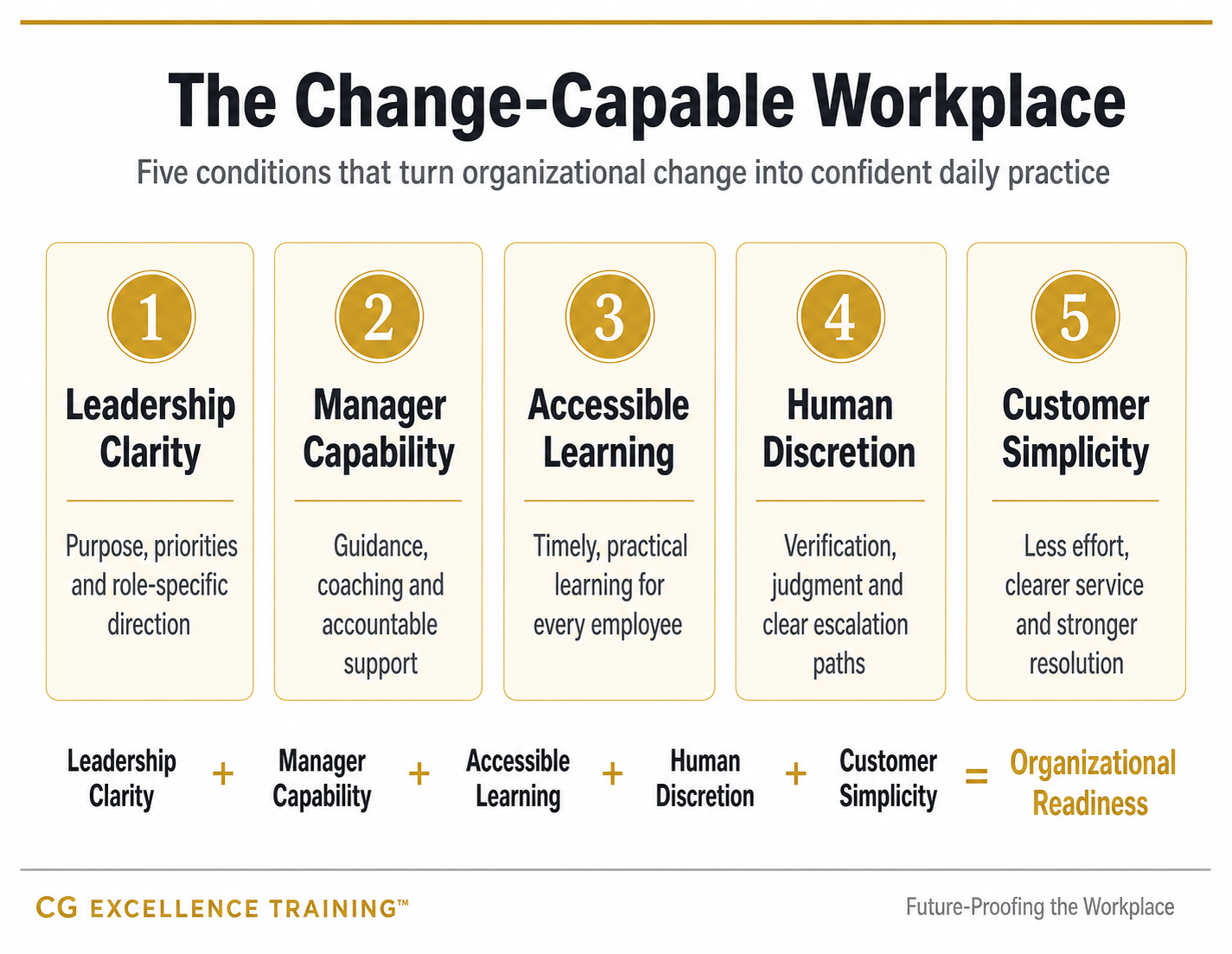
A change-capable workplace brings five conditions together:
Leadership clarity
Employees understand the purpose of change, the priorities guiding it and the role they play in successful implementation.Manager capability
Managers have practical guidance, coaching resources and clear accountability for helping employees apply change in daily work.Accessible learning
Employees receive timely, practical and inclusive learning opportunities that build confidence as roles, customer expectations and tools evolve.Human discretion
Employees understand where verification, judgment, empathy and escalation support responsible decisions.Customer simplicity
New systems and processes reduce customer effort, improve clarity and support stronger resolution.
Together, these five conditions create organizational readiness.
Put the Framework Into Practice
The Future-Proofing the Workplace Fillable Leadership Workbook helps leaders assess organizational readiness, strengthen manager capability, build employee confidence and translate change into practical action.
The workbook includes readiness assessments, manager-conversation planning tools, learning-access prompts, professional-discretion and escalation exercises, customer-experience review questions and a focused 30-, 60- and 90-day action plan.
Get Immediate Workbook Access — $28
Managers Translate Change Into Daily Reality
Managers translate organizational ambition into practical direction for daily work.
The role becomes especially visible with artificial intelligence. Gallup reported that 99% of 102 chief human resources officers surveyed considered AI important to organizational strategy. Half expressed limited confidence in managers’ ability to guide employees in AI use, and 57% reported providing AI training for people managers.gallup+1
Manager support also influences how employees experience technology. Gallup found that employees who strongly agreed their manager champions AI were much more likely to say AI had transformed how work gets done. Employees receiving active manager support were also more likely to report improvement in workplace culture.gallup
Managers help employees understand:
Where AI can appropriately expand capacity
Where information requires verification
When a human decision is needed
How performance expectations are evolving
Who remains accountable for the outcome
How technology can improve the customer experience
AI literacy extends beyond operating a tool. It involves applying technology responsibly within the realities of a role, customer relationship and organizational values.
Technology strategy becomes practical when managers can translate it into confident, responsible daily practice.
Continuous Learning Builds Confidence
A future-ready workplace makes learning part of how the organization works.
Employees benefit from timely, relevant opportunities to build capability as roles, customer expectations and tools evolve. Effective learning creates confidence through practical application, accessible resources, manager reinforcement and regular opportunities to practice and improve.
Accessibility belongs within the definition of organizational readiness. Captions, screen-reader compatibility, keyboard navigation, readable contrast, plain language and alternative formats help ensure learning resources can serve every employee expected to use them.
The Equal Employment Opportunity Commission’s 2026 Pearson Education settlement illustrates the importance of accessible workplace systems. The EEOC alleged that visually impaired employees did not receive equal access to required online platforms for training, benefits and leave. The agreement included accessibility audits, improvements to training modules, annual accessibility training for HR personnel and ongoing compliance measures.eeoc+1
A learning resource strengthens the workforce when it is usable, relevant and connected with the work employees are expected to perform.
Human Discretion Creates Value
As technology supports more routine work, the value of distinctly human capability becomes more visible.
Employees will continue to interpret context, recognize when a standard answer does not fit the situation, understand the person behind a request and determine when a matter benefits from verification, empathy, escalation or a different course of action.
The capability is especially important in customer-service leadership and service excellence. Customers experience digital systems, policies and frontline interactions as one organization.
J.D. Power found that overall small-business customer satisfaction with commercial insurers reached 750 on a 1,000-point scale when both the insurer and the agent completely understood the customer’s business, compared with 547 when neither did. a 203-point difference.
Digital access can make service easier to reach. Human understanding makes service more relevant.
Employees benefit from more than system knowledge or a script. They need the ability to ask exploratory questions, interpret circumstances, explain clearly and take confident ownership of a customer need.
Human discretion, supported by sound principles, clear boundaries and appropriate escalation, helps an organization respond intelligently when customer needs require more than a standard workflow.
Technology Should Simplify Experience
One of the most meaningful measures of readiness is the experience customers have after a new process or system is introduced.
Leaders can ask:
Has customer effort been reduced?
Can frontline employees resolve more needs with confidence?
Is help easier to obtain when technology requires human review?
Has the process become clearer for customers and employees?
Does the technology support stronger resolution and customer confidence?
Customer-centered implementation reduces effort, improves clarity and enables stronger resolution alongside operational efficiency.
Simplicity is a service skill. Employees create simplicity when they listen, interpret, explain and resolve with confidence.
Discernment Guides Investment
Future-proofing requires thoughtful discernment about which emerging capabilities best serve the organization.
Gartner forecast that inference costs for agentic AI workflows could rise more than fivefold through 2028 as multistep agent workflows require significantly more computational resources than basic chatbot interactions. Forecasts evolve with technology and economics, while the leadership principle remains relevant: technology creates the greatest value when it fits the work, customer experience, cost structure and organizational priorities.
Each AI-supported workflow benefits from a named human owner and evaluation through meaningful criteria:
Accuracy and verification requirements
Customer effort and customer confidence
Employee workload and capability
Privacy, risk and accountability
Total cost and operational requirements
Quality of the final outcome
Human capability provides the discernment that guides where, when and how technology supports organizational performance.
Five Leadership Priorities
Leaders can create the conditions in which people respond confidently to expected and unexpected change.
1. Build manager capability
Equip managers with role-specific guidance, practical examples, ethical boundaries and clear escalation paths before asking them to lead employees through a change.
2. Make learning part of the work
Create brief, accessible and recurring opportunities to practice, reflect and improve as work evolves.
3. Clarify human discretion
Identify decisions that benefit from context, empathy, verification or accountability. Provide employees with principles, decision guidance and escalation support.
4. Measure demonstrated competence
Training completion provides attendance information. Demonstrated competence shows whether employees can explain the change, apply it in their role and recognize when human review is valuable.
5. Evaluate change through customer experience
Review each new process through customer effort, clarity and resolution. Customer-centered improvement supports efficient operations and meaningful service.
The Human Capability Advantage Is Built Now
The strongest organizations develop people who move through uncertainty with responsibility, confidence and a continuing focus on the human connection at the center of the work.
The human capability advantage includes adaptability, curiosity, discernment, empathy, accountability and the confidence to act wisely.
Together, these qualities help organizations interpret change thoughtfully, apply technology responsibly and create better experiences for employees and customers.
The future of work will continue to evolve. Systems will change. Roles will be redesigned. Customer expectations will rise. Every organization can cultivate the human capability advantage and strengthen the people who will meet change with purpose.
Turn Readiness Into Leadership Action
The Future-Proofing the Workplace Fillable Leadership Workbook translates the article’s framework into a practical process for leaders, managers, HR professionals and learning leaders.
Use the workbook to:
Assess employee and manager readiness for change
Clarify leadership messages and manager conversations that support adoption
Identify opportunities for practical learning, accessible resources and role-specific confidence
Define where human discretion, verification and escalation support quality decisions
Review change through employee and customer experience
Create a focused 30-, 60- and 90-day readiness action plan
Format: Fillable PDF
Access: Immediate digital download
Designed for: CEOs, business owners, HR Directors, managers and L&D leaders
Individual Participant License: $28
Get Immediate Workbook Access — $28
Continue the Conversation
The human capability advantage grows through leadership clarity, manager practice, accessible learning, sound discretion and a consistent commitment to customer understanding.
Ready to build a more change-capable workplace?
Access the Fillable Leadership Workbook — $28
Explore CG Excellence Training’s Distinctive Specialties.
Contact CG Excellence Trainingto begin a conversation
Sources
U.S. Equal Employment Opportunity Commission, Pearson Education settlement, August 21, 2026
J.D. Power, 2026 U.S. Small Commercial Insurance Study, August 18, 2026
American Customer Satisfaction Index, Entertainment Study, August 18, 2026
Thank you for your kind attention today. May this Leadership Article support you in strengthening the human capability and discernment your team needs to navigate change.
Christine