BRIGHT $POT
Turn Everyday Success Into Enterprise Capability
Executive Summary: Organizations routinely celebrate a successful contribution and then move on, leaving the learning inside it unused. Every meaningful win holds evidence of what worked, why it worked and which conditions supported it. Executives can turn that evidence into capability by noticing one win, verifying its cause, protecting the conditions behind it, transferring the practice to another team and measuring what changes. The result is a clearer view of how performance creates more performance and where development creates lasting value.
When Marriott piloted an AI-driven room-assignment engine, it faced a concern many hospitality leaders recognize: employees often see new technology as a threat. The company positioned the pilot as a way to empower its people. Frontline staff co-designed the tool alongside developers, shaped its workflows and decision rules, and kept the authority to override it. BCG reports that the system now processes more than 1.2 million room assignments across the chain in seconds (2026).
The way the tool was built holds a lesson. People who know the work shaped the solution, and leaders protected their authority to question it. That raises a question any organization can ask: What could this win teach everyone else in the organization?
That question is the BRIGHT $POT. A bright spot contains evidence. It shows leaders what worked under real operating conditions, and what could work again. Ten isolated wins create progress. Compounding wins create capability.
Three takeaways follow:
Notice and verify the win before you celebrate it.
Protect the conditions that made it possible.
3. Transfer the learning and measure what changes.
Takeaway 1: Notice and verify the win
Noticing a win starts the process. Verifying it decides whether the win deserves to travel, and for whom.
Alibaba tested a generative AI assistant with customer-service agents in a large randomized field experiment on after-sales service. The assistant improved service speed and customer ratings, and lower performers gained the most, which narrowed the gap between agents. Top performers showed little improvement in speed, and their service quality declined. The evidence points to more multitasking across concurrent chats, which slowed responses to customers (2026 working paper). A second Alibaba experiment, testing AI that handles chats on its own, found faster service without better service quality.
A result that looks like a win on one measure can hide a cost on another. Verification means asking who benefited, who did not and why.
Try this. When a team, employee or manager produces an unusually good result, ask:
What happened, and who contributed?
What did they do differently?
Why did it work, and what evidence shows it?
Who benefited, who did not and why?
Takeaway 2: Protect the conditions
A win depends on time, information, authority, supplies, trust and incentives. When those weaken, the result becomes hard to repeat.
Marriott's pilot shows two of them at work. Trust: the company invited employees to help build the tool. Authority: staff kept the ability to override the system's decisions. Those are conditions leaders can protect as a pilot grows.
Incentives are a condition too. In the customer-support study discussed in The Inverted Hierarchy (Quarterly Journal of Economics, 2025), the researchers suggest the AI assistant's gains came in part from capturing the tacit knowledge of top performers. Brynjolfsson, a co-author, has noted that companies need incentive and reward systems that recognize those top performers, because they create knowledge the whole organization depends on.
Try this. Before scaling a promising practice, ask:
Which information, authority, relationship or resource made this possible?
Who invests the time to adopt it, and who benefits?
What support makes adoption practical?
Takeaway 3: Transfer the learning and measure what changes
Trip.com, the travel technology company based in Shanghai, tested a practice before spreading it. In a six-month randomized trial, 1,612 graduate employees in its airfare and IT divisions were assigned either to work in the office five days a week or to have the option of working from home on Wednesdays and Fridays. Attrition in the hybrid group fell by about a third and job satisfaction improved. Performance grades and promotion rates did not differ between the groups. Managers had expected a productivity drop of about 2.6 percent, and their attitudes became more favorable during the trial. The company then rolled hybrid work out to all employees (Nature, 2024). The company's reasoning was financial: each departure cost about $20,000 in recruitment and training.
A tested practice became a company-wide capability, and the company had the evidence to show what changed.
Hospitality is measuring this kind of change too. BCG reports that the Ritz-Carlton San Francisco implemented an AI system that synchronizes room-cleaning schedules with check-outs, guest preferences and staff availability, speeding up room preparation by 20 percent.
Learning stays with an individual unless the organization builds a way to share it.
The path looks like this:
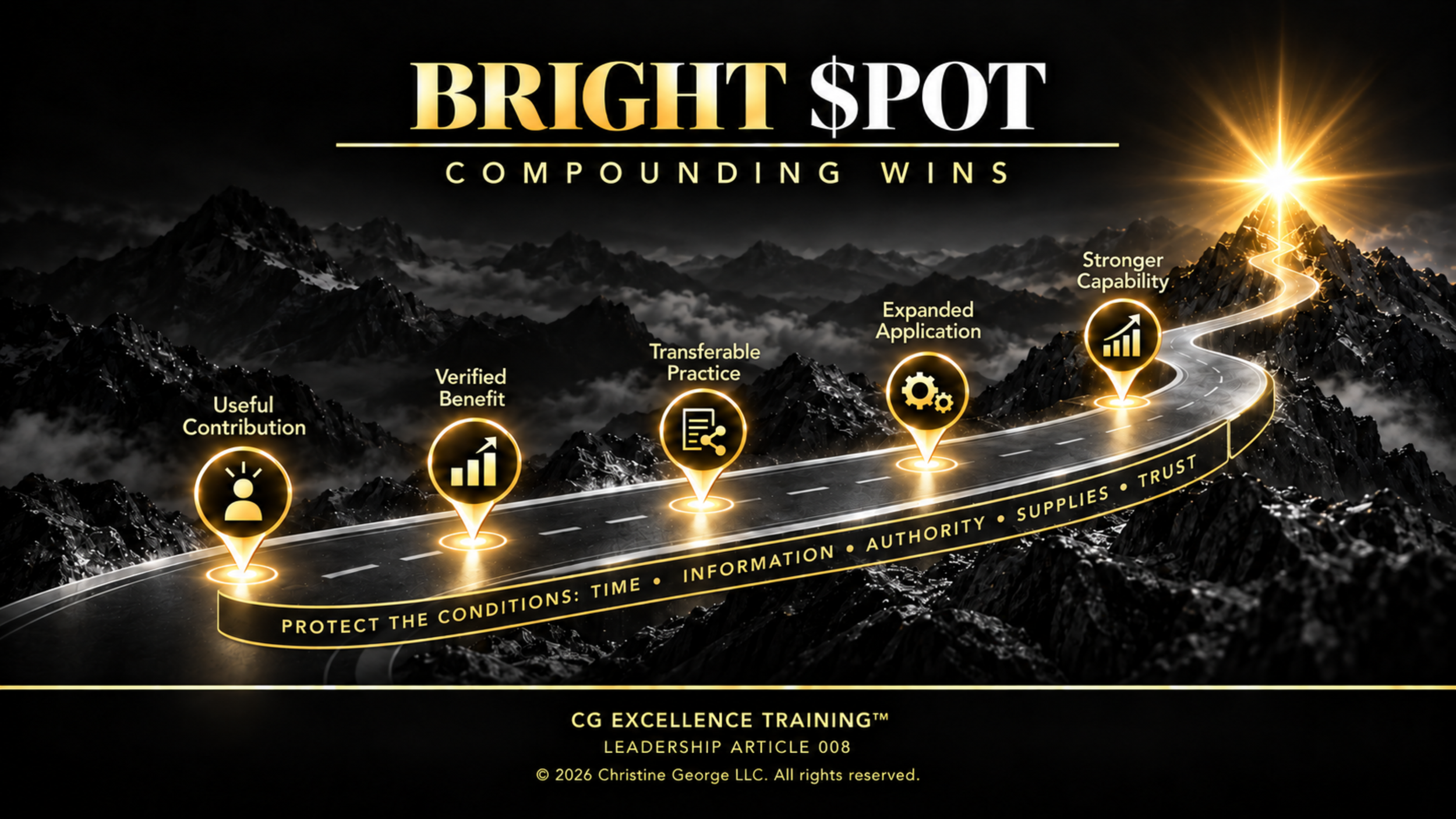
Useful Contribution → Verified Benefit → Transferable Practice → Expanded Application → Stronger Capability
Specific recognition is one of the simplest ways to start. "Great job" ends the conversation. Compare it with: "The way you organized the customer information helped the team resolve the issue without escalation. Let's understand why it worked and where else it could help." The employee knows what mattered, and the team has something to apply.
Try this. Measure whether the win made the next win easier. Useful indicators include rework, escalation rates, time to competence, customer experience, manager capacity, retention and adoption across teams.
What this means for you
CEOs. Performance includes current output and future capacity. A process improvement that frees time creates value, and a practice that helps several teams solve future problems creates broader enterprise value. Ask: Where is performance creating more performance?
HR directors. Development matters most when its benefits reach beyond the participant. Completion rates and satisfaction scores remain useful. Also ask whether coworkers benefited, whether quality improved, whether rework fell and whether new employees became competent faster.
Business owners. Proximity to the work is an advantage. Listen when employees say:
"We found an easier way."
"That problem stopped happening."
"She showed the rest of us how to do it."
These comments are often early signals of capability worth examining.
Where to start on Monday
Choose one win from the past thirty days. Gather the people involved for fifteen minutes and ask:
What did we do?
Why did it work?
What conditions supported it?
Where could we apply it next?
The Bright Spot Worth Finding
Businesses devote considerable energy to what they need next: more technology, more people, more training, more systems. Growth sometimes requires those investments. Leadership also benefits from studying strengths already present in the work: a process someone quietly improved, a manager who developed someone well, a team that resolved issues without escalation.
These moments rarely arrive labeled as strategy. Yet a meaningful win may contain the beginning of a transferable practice, stronger capability or useful evidence. The event lasts a moment. The learning can create value long afterward.
Continue the Work
Fifteen minutes will surface a promising practice. Turning it into capability takes a more disciplined review.
The BRIGHT $POT | Compounding Wins Interactive Workbook is a 27-page guide that follows the path in this article: Notice, Verify, Protect, Transfer and Measure. You will choose one meaningful win, map why it worked and which conditions supported it, design a focused transfer test, and follow a 30-, 60- and 90-day plan.
Choose the edition that fits:
Individual License for one leader working through a win personally
Team or Organizational License for leadership meetings, department reviews and manager development
The workbook works best in desktop Adobe Acrobat, where the scoring and summary pages calculate automatically.
Begin with one meaningful win already happening inside your business.
Thank you for spending this time with me. I hope this article encourages you to look closely at the good work already happening around you, and to see how one win can strengthen the next. Your people are doing something worth learning from right now. Begin there. Christine
Research Notes
Marriott and Ritz-Carlton San Francisco: BCG, "AI-First Hotels: Faster to Build, Leaner to Operate, and Richer in Customer Experience," March 2, 2026. https://www.bcg.com/publications/2026/ai-first-hotels-leaner-faster-smarter
Alibaba customer service: Ni et al., "Generative AI in Action: Field Experimental Evidence from Alibaba's Customer Service Operations," working paper, 2026. https://arxiv.org/abs/2603.29888. Also "Agentic AI and Human-in-the-Loop Interventions," working paper, 2026. https://arxiv.org/pdf/2605.14830
Customer-support study: Brynjolfsson, Li and Raymond, "Generative AI at Work," Quarterly Journal of Economics, 2025;140:889-942. https://doi.org/10.1093/qje/qjae044
Trip.com study: Bloom, Han and Liang, "Hybrid working from home improves retention without damaging performance," Nature, 2024;630:920-925. https://www.nature.com/articles/s41586-024-07500-2
© 2026 Christine George LLC | CG Excellence Training™. All rights reserved.