Service Excellence
The Leadership System Behind the Experience
Executive Summary: Customers judge service by the person in front of them, yet that person's success rests on decisions made far from the point of contact: staffing, information, authority, technology, process and coaching. Gallup's 2026 research shows 43% of U.S. employees strongly agree with feeling great responsibility for the customer experience, while only 23% strongly agree their organization always delivers on customer promises. article introduces the Service Excellence Architecture, eight connected conditions leaders can examine, and three moves to apply in sequence: diagnose before prescribing training, measure conditions before the customer score moves, and move capability closer to the customer. The result is a view of service as a leadership system that CEOs, HR directors and business owners can design, measure and improve.
One Member, Eight to Twenty Screens
Consider a service employee at CareFirst BlueCross BlueShield, helping one member. To serve that member, she may move among eight to twenty screens.
Forrester reports that CareFirst found this when the company examined digital capabilities. The friction landed on employees and on the members they supported.
The answer came from the design of the work. Service and technology teams overhauled the service-center tools around a clear view of the customer, the history and the path to resolution.
A capable employee was already on the line. The environment had to catch up.
The gap between an employee's ability and the organization's permission is where service is won or lost. Service excellence describes an organization's repeatable ability to keep a promise, understand a need, resolve an issue and recover trust across people, processes and channels. A customer rating captures one person's evaluation. The capacity behind thousands of strong experiences is what leaders build.
The Gallup Findings
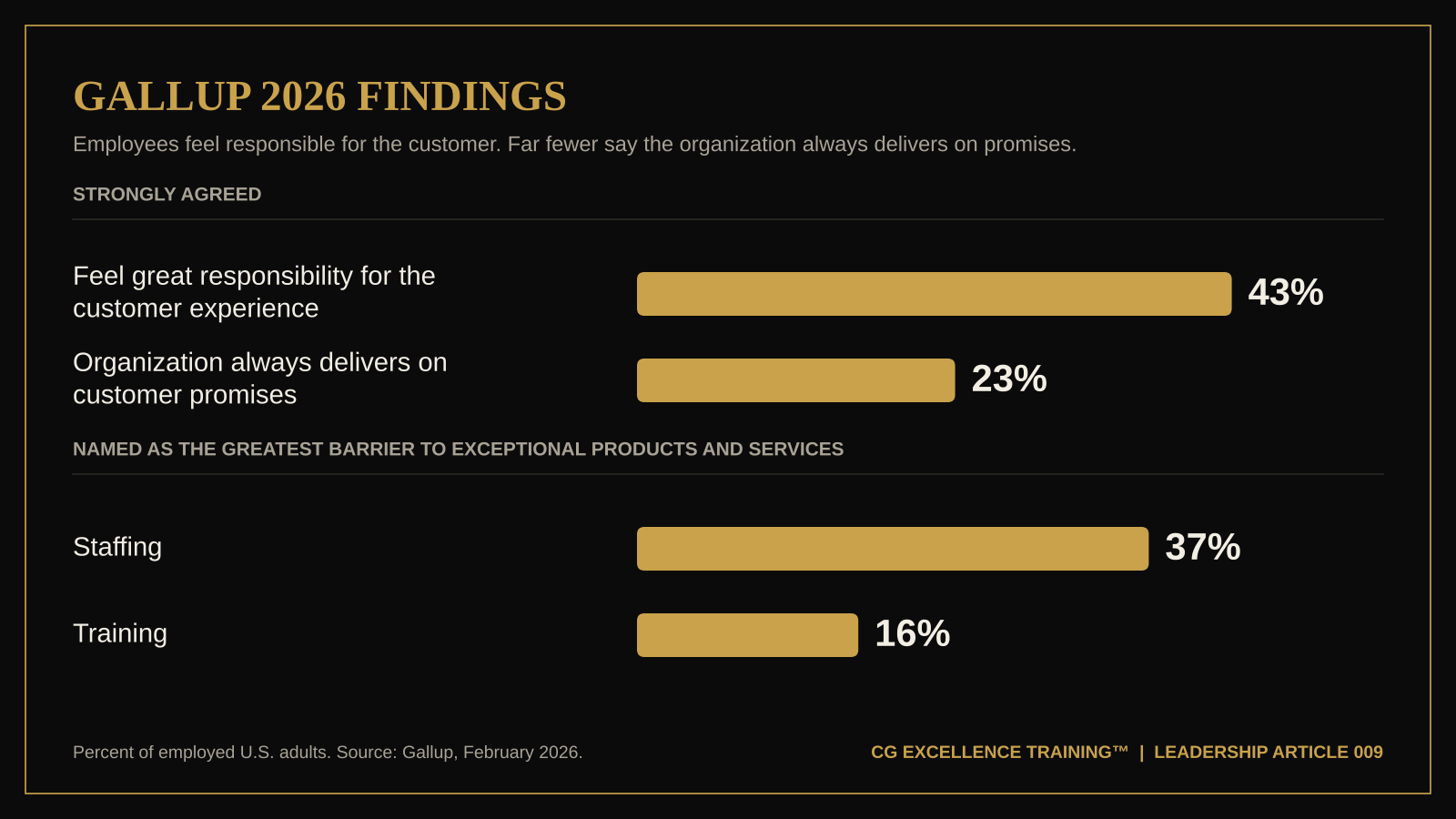
Nearly twice as many employees feel personally responsible for the customer experience as believe their organization keeps customer promises. Gallup's February 2026 report puts numbers to the gap.
Staffing surfaced more than twice as often as training. Service improves when leaders examine both sides of the experience: the human capability at the point of contact and the organizational design surrounding that capability.
Service Is Decided Before the Customer Calls
From the customer's side, service looks simple: ask a question, place an order, fix a bill, change an appointment, return a product. Behind each moment sit decisions the customer never sees: who owns the process, how many people are scheduled, how much information employees can reach, where approval thresholds sit.
The same pattern shows up at smaller scale. Consider a 40-person home-services company. The scheduler has the customer's address, the technician remembers the repair history, and the invoice sits in a third system. A customer disputes a charge, and three people each hold one piece of the answer. Each person works quickly, and the answer still takes three conversations to assemble.
Both stories point to a question any leadership team can ask: how much organizational friction does an employee navigate before helping a customer?
The Price of Friction
Most service dashboards count handled contacts. A leadership view follows a need all the way to resolution and adds up everything required to reach that point.
Cost per resolved need = total cost of every contact, transfer and follow-up, divided by the number of needs fully resolved.
Here is an illustration with round, invented numbers. A customer's billing question takes three handled contacts, two of them transfers. At eight dollars of staff time and systems per contact, that single need costs 24 dollars. A direct resolution costs eight. One employee, one skill set, three times the cost, and the arithmetic leaves out the approval delay and the customer's patience.
Replace the eight dollars with your own figure, multiply by the repeat contacts your team handles each month, and the conversation about design moves from preference to budget.
Two Different Gaps
Service concerns often reveal two distinct gaps, and each calls for a separate response.
Capability gap
- Typical signs: An employee needs better discernment, product knowledge, communication skill or recovery practice.
- Leadership response: Training and coaching.
Architecture gap
- Typical signs: An employee has the skill, while policy, technology, information, staffing, process or authority limits where that skill can be used.
- Leadership response: Redesign of the surrounding conditions.
Many situations involve both: a representative who needs stronger product knowledge and a clearer approval path, a manager who needs coaching skill and better visibility into the work, a customer who needs a simple digital route alongside access to a skilled person.
A good intention still needs a road to travel.
Gallup's finding that staffing outranks training as an obstacle, and CareFirst's screen-switching, show how often an architecture gap sits behind an apparent capability gap.
The Service Excellence Architecture
1. Authority: Is decision authority matched to the level of risk and customer need?
2. Information: Can employees see customer history, prior actions and relevant guidance in one view?
3. Capability: Have judgment, knowledge, communication and recovery skills been developed for the work?
4. Manager proximity: Do employees have timely guidance, coaching and decision support?
5. Process: Will the workflow guide each need toward clear resolution?
6. Technology: Does the technology preserve context and extend the employee's reach?
7. Capacity: Are time, staffing and resources sized to demand volume and complexity?
8. Enterprise alignment: Is responsibility for the complete outcome shared across HR, technology, operations, finance, risk and customer-facing teams?
Excellence in an Ordinary Moment
A customer asks for a product that is missing from the shelf. One associate says, "We don't have that in stock." Another says, "I don't see that in stock. Let me check whether another store can ship that to you. If not, let's figure out together how to get you what you need."
The second response is knowledgeable and confident. Behind that response, several conditions are working together: accurate information is within reach, authority matches the transaction, technology supports the task, the process keeps ownership with the associate, and the organization trusts that person to act within clear boundaries.
Strong architecture is nearly invisible. The customer feels ease, the employee feels supported, and the promise is kept through ordinary, repeatable behavior.
A Two-Minute Friction Check
Pick your busiest service line and answer yes or no:
Can an employee see the full customer history without leaving one screen?
Are the three most common requests resolved by frontline employees without a manager?
Will a transferred customer avoid repeating the story?
Does your team track how many contacts one need takes to resolve?
Is there a route for frontline observations to reach the owners of process and technology?
Each no marks a place where capable people are working around the system. The Service Excellence Architecture Assessment in the workbook examines all eight conditions, and the Frontline Authority Audit takes question two further.
One Customer, One Organization
A customer sees one company. Behind that single face, every experience travels through layers of people and decisions, and crosses channels along the way.
The Experience Chain
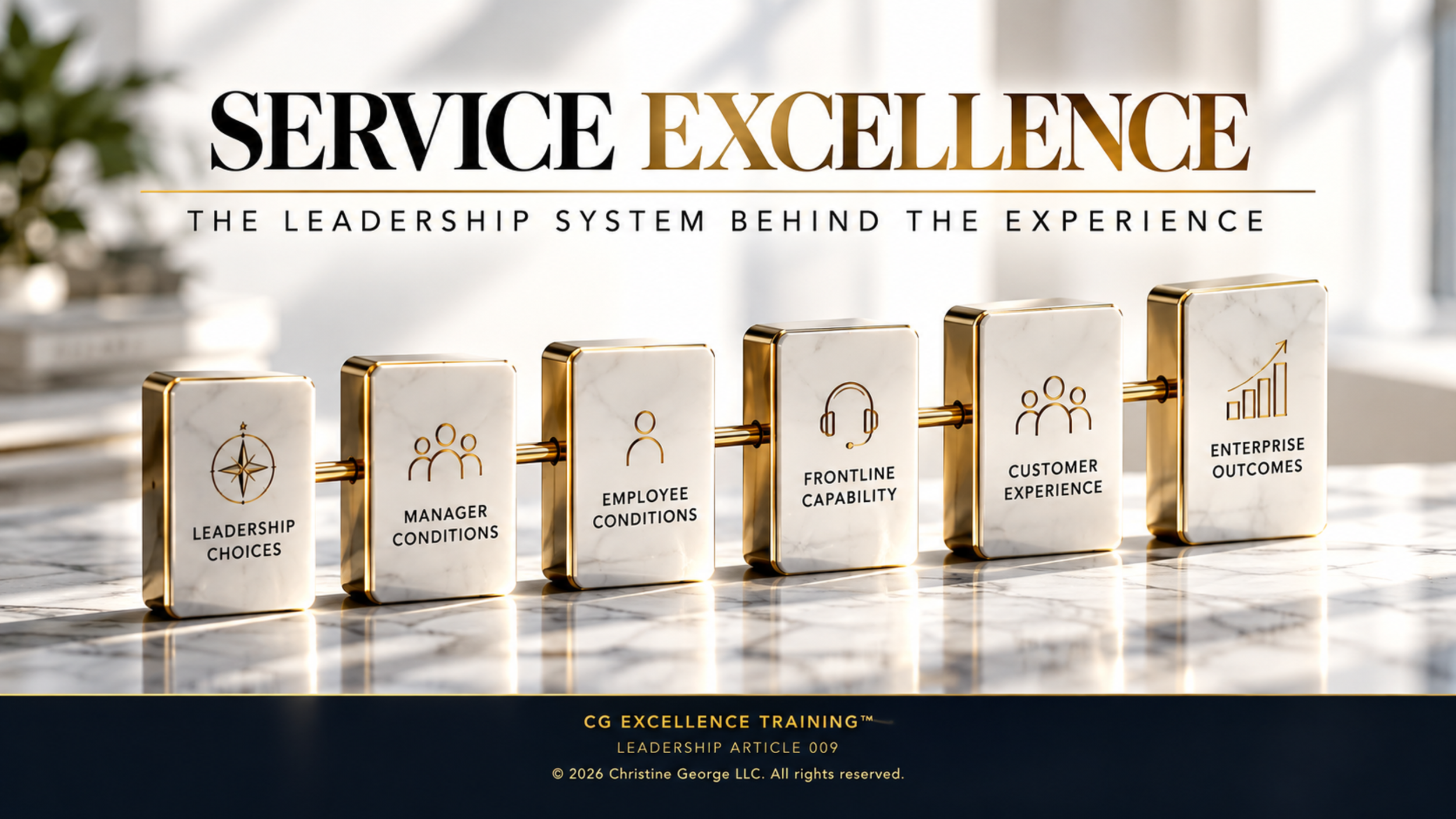
Leadership choices shape the conditions managers work in. Managers shape the environment employees experience. Employees turn that environment into judgment, behavior and execution, and customers meet the result.
Handoffs the Customer Can Feel
Customers rarely see departments the way organizations do. A journey can move from an app to a phone call, from a service desk to a billing team, from a local site to a central office.
J.D. Power's 2026 life insurance study shows the value of continuity. Policyholders who strongly agreed their phone, digital and in-person channels were seamless gave trust scores 148 points higher than those who somewhat agreed. A difficult experience, such as trouble reaching a representative or an unexpected fee, came with a 96-point decline in trust.
An internal transfer can feel like a personal restart for the customer. A well-designed handoff passes the story forward so the next employee can continue with confidence.
Empowerment With Boundaries
Moving authority closer to the customer creates real value, a principle explored in The Inverted Hierarchy. The practice lasts when employees understand the boundaries around a decision. Healthcare, financial services, insurance and transportation all require consistency, privacy, fairness, legal authority and risk awareness.
A working definition: empowerment is sufficient authority within understood boundaries, supported by information, capability and accountable escalation.
Each part has a job. Information lets the employee see. Authority lets them act. Capability lets them judge. Escalation protects the customer and the organization when a case reaches past the boundary. Together, the four parts empower the frontline to discern the right move in the moment.
Three Leadership Moves
1. Diagnose Before Prescribing Training
When a service concern surfaces, start with recent customer experiences and trace each one backward. Take several cases and ask:
Where does the first slowdown appear?
Was information available at the moment of need?
Could an approval interrupt resolution?
How closely do staffing levels match demand volume and complexity?
Will the technology keep the customer's history in view?
Can a handoff add another explanation, queue or contact?
Is a reasonable resolution blocked by policy?
The review points accountability at conditions leaders can improve.
2. Measure Conditions Before the Customer Score Moves
Satisfaction and Net Promoter scores report outcomes. The conditions producing them become visible earlier, through measures such as:
Time spent searching for information
How often managers must approve
Transfers per resolved need
Repeat contact within seven or thirty days
Digital interactions that continue through a human channel
Escalations traced to policy, authority or inaccessible information
Customer effort across the full journey
One measure deserves special attention: cost per resolved need, introduced earlier. Speed gains value alongside resolution, and containment gains value alongside a complete answer. The principle connects to BLIND $POT | Cascading Consequences: demand that leaves one metric continues through another part of the organization.
3. Move Capability Closer to the Customer
List the ten most common reasons a frontline employee seeks approval or transfers ownership. For each, ask:
Which decisions could be resolved safely closer to the customer?
How would added information widen that list?
How far could stronger judgment stretch the list?
Where is a manager or specialist genuinely required?
Managers add value where judgment, coaching, risk assessment and broader coordination are needed. Employees add value when information, capability and authority fit the customer's need. Each appropriate decision resolved closer to the customer strengthens continuity, speed and confidence.
When the System Learns From the Frontline
Frontline employees receive a steady stream of organizational intelligence:
Confusing policies, heard firsthand.
Screens customers struggle to navigate.
Explanations requested again and again.
Workarounds people use.
One concern, arriving for the tenth time.
A clear route from those observations to leaders, process owners and technology teams turns the intelligence into action. A recurring question may signal a communication opportunity. A repeated workaround may point to a process improvement. A pattern of transfers may reveal an authority or information decision worth reviewing. When employees surface their observations and leaders respond with curiosity and action, the frontline becomes an organizational sensing system.
BRIGHT $POT | Compounding Wins offers a related principle. A successful local solution holds information about the conditions behind the win. Leaders who protect those conditions spread the learning across the organization, and service excellence scales when wins become easier to repeat and depend less on individual heroics.
Five Ideas to Bring to Your Next Leadership Meeting
Service quality is a leadership output. Staffing, information, authority, process and trust all reach the customer through the frontline.
Diagnosis comes first. Training pays off once capability has been identified as the opening.
Complete resolution is the real efficiency measure. Repeat contacts, transfers and customer effort belong in the count.
Empowerment is a design. Authority works alongside information, capability, boundaries and escalation.
The frontline is an intelligence source. Repeated questions, workarounds and transfers point to improvements in the operating design.
The Question Worth Asking
The employee remains central. Judgment, skill and empathy give the system a human expression, and leadership adds a wider question: has the organization created conditions where that capability can consistently produce value for the customer? When employees regularly search, wait, explain or absorb process frustration, the pattern is design information.
A Ten-Case Exercise
Choose ten recent customer-service issues and examine each through the eight conditions of the architecture.
Then ask:
What could we change so delivering the experience we promise becomes easier for a capable employee?
The patterns across those ten cases become your improvement agenda, and each pattern needs a named owner. Who in your organization holds the authority to make that change? The companion workbook turns them into a structured diagnosis and leadership action plan. [Insert workbook link.]
Why This Matters to Me
From what I see on the front line, the difference comes down to engagement. One employee is there for the mission, and another is there for the paycheck. The customer receives the service that follows. Engagement grows when leaders invest in people and bring out their inner brilliance.
I believe a frontline leader is only as strong as the tools, support and training the organization provides. The CG workbooks are instrumental to this end.
An HR leader, manager or trainer can guide frontline professionals on their own through an interactive workbook that calculates scores and summaries as the team works. Needs and culture differ from one organization to the next, so the exercises can be curated around those specifics and presented at the team's pace in any time zone, whether in a weekly meeting or on a Zoom call. Use the workbook however you see fit for the best outcome of your company.
Turn Insight Into Organizational Capability
The SERVICE EXCELLENCE | The Leadership System Behind the Experience Interactive Workbook gives your leadership team structured tools to examine the conditions behind service in your own organization:
Service Excellence Architecture Assessment
Capability and Architecture Diagnostic
Frontline Authority Audit
Internal Service-Chain Map
Customer-Friction Trace
Digital-to-Human Handoff Test
30/60/90-Day Architecture Improvement Plan
A 90-minute path through the workbook shows where to begin.
Select the edition that fits:
Individual License for one leader working through the diagnosis personally
10-Participant Team License for leadership meetings and department reviews
25-Participant Organization License for manager development across functions
The workbook works best in desktop Adobe Acrobat, where the scoring and summary pages calculate automatically.
Begin with ten recent customer issues already waiting inside your business.
We would like to hear the first friction point your team finds.
Service excellence becomes practical when organizational design allows human capability to reach the customer.
Thank you for your kind attention. I hope this article encourages you to look closely at the conditions around your people, and to see the difference a clear path makes. Your employees already care about the customer. Start there. Christine
Next in the Series
Leadership Article No. 010, THE FIRST LAYER | Investing in Your Frontline, explores how leaders invest in the people who meet the customer every day. Every promise the organization makes is kept or broken at the first layer.
Continue Exploring CG Excellence
The concepts behind Service Excellence:
The Last Human Mile, human judgment at the point of value.
The Inverted Hierarchy, moving authority closer to the work.
BLIND $POT | Cascading Consequences, transferred demand and downstream consequences.
BRIGHT $POT | Compounding Wins, turning successful contribution into repeatable organizational capability.
For the human side of performance, continue with Frontline Ingenuity Audio and Frontline Ingenuity Articles and CG Excellence YouTube channel, where shorter reflections explore identity, perception, judgment, emotional fitness and individual contribution.
CG Excellence develops the capabilities supporting organizational performance.
Work With CG Excellence Training
Service excellence starts with a close look at the conditions around your people. CG Excellence Training offers customized recorded training resources aligned with organizational priorities, manager development and workforce needs. Contact us to begin a conversation about performance development for you and your team.
Visit cgexcellencetraining.com.
Research Notes
Gallup, "Is Staffing Eroding Customer Experience?" (February 22, 2026): a survey of 23,068 employed U.S. adults, conducted August 5–19, 2025. https://www.gallup.com/workplace/702329/staffing-eroding-customer-experience.aspx
Forrester, "Six Lessons In Experience Leadership From Forrester's 2026 Total Experience Honorees": research on CareFirst BlueCross BlueShield. https://www.forrester.com/blogs/six-lessons-in-experience-leadership-from-forresters-2026-total-experience-honorees/
J.D. Power, 2026 U.S. Individual Life Insurance Study (October 2026): 6,145 customers, fielded July 2025 through July 2026. https://www.jdpower.com/business/press-releases/2026-u-s-individual-life-insurance-study/
© 2026 Christine George LLC | CG Excellence Training™. All rights reserved.