First In Line
Investing in Your Frontline
Executive Summary: The first in line are often the ones through whom the customer first experiences the organization. That same group is expected to absorb information, technology, policy, change and customer expectations, then turn them into competent performance. Frontline investment is therefore a leadership discipline, larger than a training decision.
Prepare → Equip → Coach → Sustain offers a practical sequence for examining what employees receive before independent performance is expected and what continues after initial competence is reached. The question that follows is whether that investment has become usable employee capability.
Consider the First Monday
Consider a frontline professional arriving for her first Monday.
Shiny new name badge on.
New login setup.
A co-worker shows her where to put her coat, where to find the schedule and which systems she will use.
There are introductions. A handbook. A few required modules. New terminology arrives quickly. She observes an experienced employee who makes the work look easier than the work really is.
By Wednesday, she understands the standard transaction.
By Friday, a customer asks a question that falls just outside that transaction.
She knows enough to recognize the issue and too little to resolve the issue confidently. She searches. She asks a colleague. The colleague is busy. A manager steps in.
The customer eventually receives an answer.
From the outside, the interaction may look like an employee who needed help.
From inside the organization, something more important has happened.
The employee has reached the edge of what the organization prepared her to do independently.
The customer may have met her on Friday.
Leadership began shaping that experience on Monday.
A Current Example: More Hands Behind the Counter
In July 2025, Starbucks committed more than $500 million to additional partner hours as part of Green Apron Service, expanding rosters and putting more employees into coffeehouses during busy periods. Starbucks described the initiative as the company's biggest investment in operating standards and customer experience.
At the time, global comparable store sales for the fiscal third quarter were down 2%. The following quarter would mark the company's first global comparable-store-sales growth in seven quarters.
One year later, Starbucks reported U.S. comparable store sales up 7.9% and transactions up 4.2% for the fiscal third quarter. The turnaround involved multiple initiatives, including menu activity, technology, coffeehouse investment and the rewards program, so the improvement cannot reasonably be attributed to labor investment alone.
Still, the company identified the frontline component directly: Green Apron Service had given employees greater time and tools to provide a more consistent experience.
Customers never read the budget.
Customers met the result.
What "First in Line" Means
First in line describes the people customers encounter first.
In one company, that may be the person answering the telephone. In another, the technician arriving at the customer's home, the associate on the sales floor, the employee behind the reception desk, the driver making a delivery, the service representative answering a message or the team member solving a problem face to face.
These employees are often where an organization stops being a strategy or a brand and becomes a human interaction.
That gives the people first in line unusual weight.
They hold expectations created elsewhere in the organization.
They represent decisions they did not make.
They explain policies they may not have written.
They use technology they may not have selected.
And they are often expected to make all of those things feel coherent to another human being.
This is why the phrase first in line has a second meaning.
The people first in line to represent the organization should never be last in line for investment.
Before asking what the frontline delivers, leadership should examine what leadership has placed into the frontline.
Investment Is More Than Training
Organizations invest in people in many ways.
Training is one of them, and only one.
An employee may complete training and remain unclear about what good performance looks like.
Another may understand the work and still lack easy access to the information needed to perform.
A highly capable employee may receive new technology with little opportunity to practice.
A new professional may begin confidently and then go months without helpful feedback.
Each employee received something.
The better question is whether what they received became something they could use.
PwC's 2026 Global Workforce Hopes and Fears Survey gathered responses from 49,364 workers across 48 countries and regions. Eighty-eight percent reported applying new skills during the previous year, yet only 51% said they had access to the learning and development resources they needed, down from 59%. Among the group PwC describes as the workforce "engine room," fewer than 40% reported that access.
Employees are learning.
The gap sits between what work requires and what the organization makes usable.
Frontline investment closes that gap.
Where Frontline Spending Becomes Investment
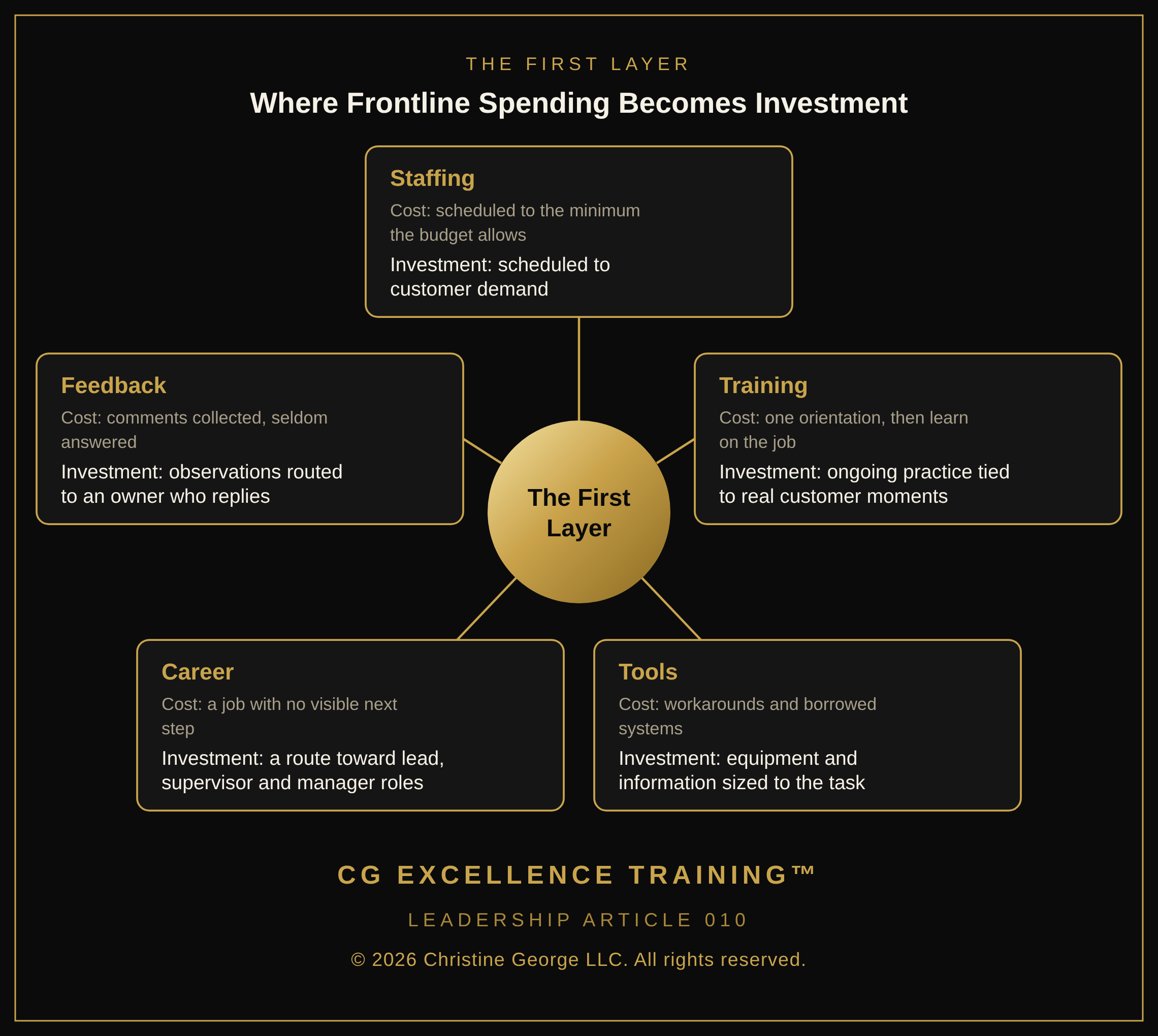
Spending does not automatically become investment.
An organization can spend money on a course, install new technology, hand out a manual or add labor hours. None of those choices tells us, by itself, whether an employee is better prepared to do the work. Investment begins when people can use what has been provided and continue building on that.
The First in Line framework is built on that difference.
The investment begins before independent performance and continues after competence has been established.
The First in Line Investment Cycle
Each stage asks leadership to examine a different part of the employee experience.
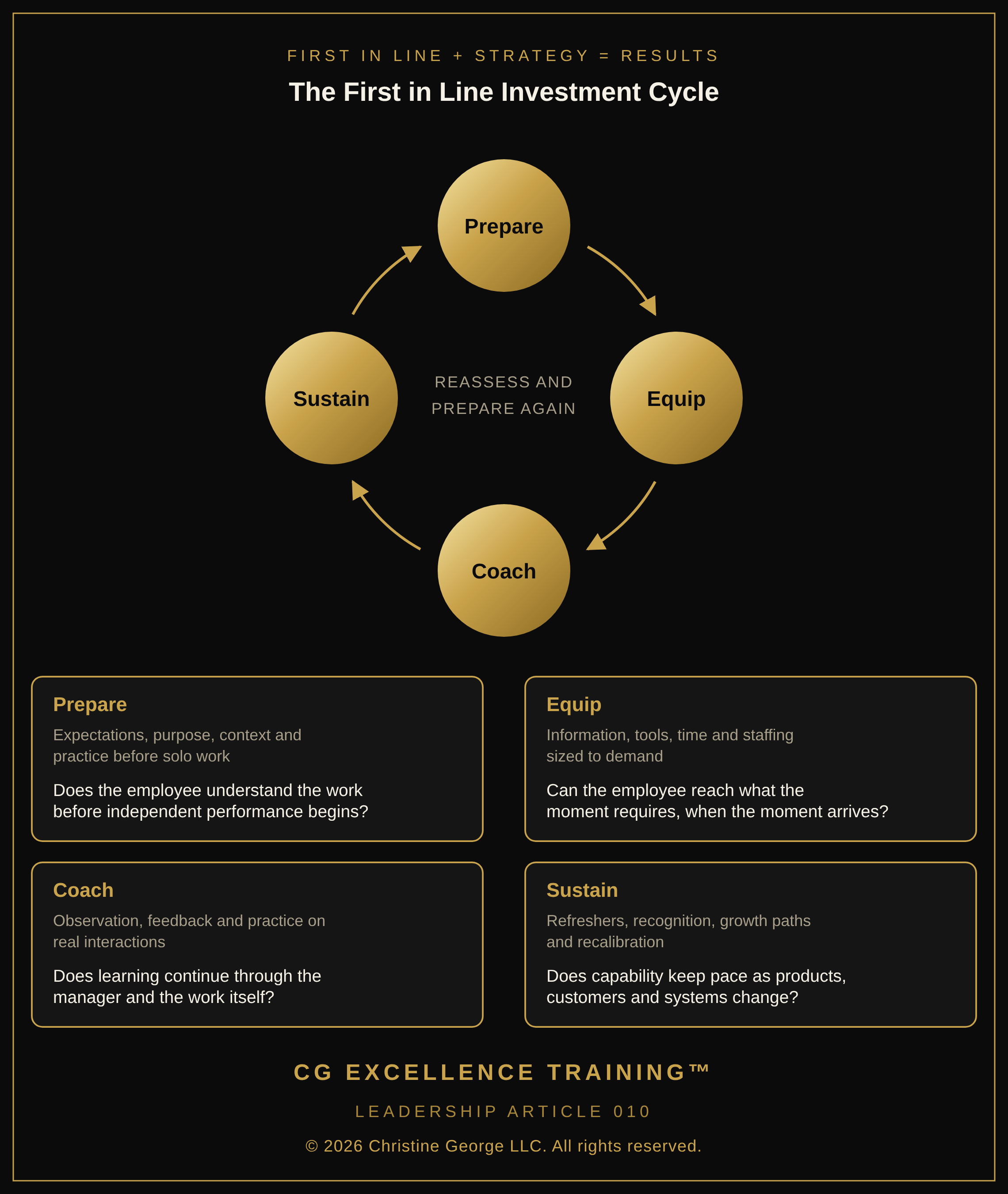
PREPARE → EQUIP → COACH → SUSTAIN
PREPARE
Preparation answers a basic leadership question:
What should this employee understand before we expect independent performance?
A prepared employee knows more than the mechanics of the job.
They understand the purpose of the role. They know what the organization promises, what customers reasonably expect, what good performance looks like and where their responsibility begins and ends.
Preparation can include formal training, and preparation also includes context.
Why does this process matter?
What happens downstream when the step is missed?
When should judgment replace a script?
What does the organization consider excellent work?
An employee who understands only the procedure may be able to repeat the procedure.
An employee who understands the work is better positioned to respond when the procedure no longer fits.
EQUIP
Preparation creates understanding.
Equipment puts capability within reach.
Equipment includes the obvious resources: systems, tools and information. Equipment also includes time, usable job aids, current knowledge and access to what the moment of work requires.
Information can exist without being accessible.
A procedure can be documented without being practical to find.
A resource becomes an investment when the employee can use the resource when the moment matters.
This is where organizations can unintentionally confuse provision with readiness.
Leaders may reasonably say, "We gave them the system. The instructions are in the portal." Both may be true. Neither tells us how easily an employee can find what is needed while a customer is waiting.
A badge and a login open the door. Preparation walks the person through.
COACH
The first customer question that falls outside the training manual is often where development really begins.
Good coaching often happens in small moments. A manager watches an interaction, asks why the employee made a particular choice, explains what worked and talks through what could be handled differently next time. Over time, those conversations help turn initial knowledge into judgment.
Frontline capability develops through the accumulation of real situations.
The manager helps the employee make sense of them.
For that reason, managerial attention belongs inside the organization's investment in the frontline.
If employees are expected to develop judgment while managers have no time to observe and discuss the work, the organization has left an important part of development to chance.
SUSTAIN
Competence is a milestone along the road, because the job does not stay still. Products and systems change. Customer expectations move. New technology alters how work gets done, and AI is already shifting which tasks stay with people.
An employee who was well prepared two years ago may be working in a very different job today.
Keeping capability current may mean new learning, timely feedback, broader responsibility or simply giving an experienced employee time to absorb what has changed. Sustaining people means continuing to invest as the work moves.
That makes the framework a continuing cycle:
PREPARE → EQUIP → COACH → SUSTAIN → PREPARE AGAIN
Each change in the work can create a new preparation requirement.
The Cost of an Unprepared Frontline
The cost of incomplete investment seldom arrives as a dramatic failure.
The cost tends to arrive in small, repeated moments.
The new employee asks the experienced employee the same question three times.
A manager regularly steps into transactions that should no longer require managerial involvement.
A capable employee learns a workaround because the new system was introduced and never fully absorbed.
Performance varies depending on who happens to be working.
Confidence takes longer to develop.
The customer receives the answer, and another employee had to stop their own work to help provide that answer.
This is why one of the most useful measures for leaders may be time to independent, consistent contribution.
Orientation completion is easy to count. The more telling question is this one:
How long did this person take to contribute capably and consistently, with an appropriate level of support?
That question makes the cost of development visible in a different way.
The answer brings several costs into view at once: a longer ramp-up, repeated manager intervention, rework and the uncertainty that comes with partial readiness.
And the answer recognizes something organizations sometimes overlook: an employee can be present in the role long before the organization has fully prepared that person to perform with confidence.
When the Work Changes, Investment Changes
Artificial intelligence makes this conversation more important.
As technology absorbs routine work, the work left to people can become more interpretive.
The employee may face the exception instead of the standard transaction, or the upset customer instead of the simple request.
Both call for judgment.
That changes what frontline readiness means.
Providing access to an AI tool is Equip.
Helping employees understand when, why and how to use the tool belongs in Prepare.
Observing how judgment develops belongs in Coach.
Refreshing capability as the technology and work continue to evolve belongs in Sustain.
The technology may be new.
The leadership obligation is familiar.
If the work changes, the investment must change with the work.
Three Ideas to Bring to Your Next Leadership Meeting
Invest before expecting. Define what ready for independent performance means, then work backward. Design preparation toward readiness, beyond the completion of orientation.
Treat managerial attention as part of the investment. Training can introduce knowledge. Observation, feedback and practice help convert that knowledge into reliable capability.
Continue investing after competence. Every change in products, systems, customers, technology or responsibility can create a new development requirement. Competence may be reached once. Capability must keep moving.
Who Owns the Frontline?
Frontline investment is usually spread across the organization. HR may oversee onboarding, learning and development may handle training, operations watches performance, technology teams manage the systems, and managers live with the daily work. Senior leadership sits above all of that.
Each group can do good work while no one sees the employee's experience from beginning to end.
That brings us to the question:
What has your organization intentionally placed into the people first in line before asking them to keep the promise?
And perhaps the more difficult question:
Who owns the continuing investment in the people your customers encounter first?
Turn Insight Into Frontline Investment
The FIRST IN LINE | Investing in Your Frontline Interactive Workbook gives your leadership team structured tools to examine the conditions behind frontline investment in your own organization, through the same four stages: Prepare, Equip, Coach and Sustain.
Role and Readiness Definition
Recent Starter Register
First in Line Investment Assessment
Priority and Cost-of-Gaps Summary
Time to Independent, Consistent Contribution Analysis
Investment Test Design
30/60/90-Day Investment Plan
The executive synthesis becomes a First-in-Line Investment Plan.
A 90-minute path through the workbook shows where to begin.
Select the edition that fits:
Individual License for one leader working through the examination personally
10-Participant Team License for leadership meetings and department reviews
25-Participant Organization License for manager development across functions
The workbook works best in desktop Adobe Acrobat, where the scoring and summary pages calculate automatically.
Why This Matters to Me
From what I observe on the frontline, engagement becomes visible.
Engagement is seen in the employee who wants to understand rather than simply finish.
You can feel engagement in the difference between completing a transaction and taking ownership of an interaction.
Employees bring their own attitudes, choices, judgment and sense of responsibility to work. Those qualities belong to the individual. Leadership's part is to give them a position to develop and matter.
When people understand what is expected, have what they need, receive steady coaching and continue to grow, they have a stronger opportunity to bring their capability into the work.
I view frontline investment as more than an HR initiative or a training expense.
Frontline investment expresses what an organization believes about the individuals entrusted to represent the organization.
The people first in line deserve investment.
When that investment becomes usable employee capability, everyone who encounters the organization has an opportunity to feel the difference.
Next in the Series
Leadership Article No. 011
MIDDLE LINE | Investing in Your Frontline Managers
The next article examines the managers responsible for turning organizational expectations into everyday frontline performance, and whether they have the capability and capacity to lead that work.
Continue Exploring CG Excellence
The thinking behind First in Line connects with The Cost of Indifference, on the unrealized value of a dormant asset; The Last Human Mile, on human judgment at the point of value; The Inverted Hierarchy, on moving authority closer to the work; and Service Excellence, on the leadership system behind the experience.
Work With CG Excellence Training
CG Excellence Training develops performance-development resources designed to help organizations strengthen the human capability behind performance.
Custom recorded training and interactive workbooks can be developed around the realities of your organization and the work your people perform.
Thank you for investing in the frontline that supports your bottom line.™
What reaches the customer begins with what reaches the frontline.
Research Note
The Starbucks example draws on the company's fiscal third-quarter 2025 and fiscal third-quarter 2026 results, fiscal fourth-quarter 2025 results, and company reporting on the Green Apron Service investment. Starbucks invested in additional partner hours as one component of a broader turnaround strategy; the subsequent sales improvement should therefore be understood in the context of multiple concurrent initiatives.
The workforce findings come from PwC's Global Workforce Hopes and Fears Survey 2026, based on 49,364 workers across 48 countries and regions and 29 sectors, surveyed in May and June 2026.
© 2026 Christine George LLC | CG Excellence Training™. All rights reserved.