Investing in Your Frontline Managers
Executive Summary: Frontline managers hold the middle line, the position where organizational intent meets the daily reality of the front line. Strategy, policy, new tools and customer expectations all arrive at the manager's desk and compete for one limited supply: attention. When coverage gaps, routine approvals, reports and corrections claim that supply first, coaching and employee development vanish without anyone deciding to cancel them. Investing in frontline managers therefore begins with the organization owning the role's design. Executives can move in sequence: clarify what each manager exists to make possible, protect the time people leadership requires, develop the skills the role demands, and reinforce those skills as the work continues. The result is managerial leverage: a front line that grows more capable and less dependent on unnecessary intervention.
The Tuesday That Disappeared
Renee blocks thirty minutes on Tuesday morning to sit beside Tyler, three weeks into the job. The plan is simple: watch Tyler handle a customer return, answer questions along the way and build some confidence.
At 8:40, a team member calls off. Renee rearranges coverage. At 9:05, a customer issue needs a manager's approval. At 9:30, a report due before noon still waits on two numbers. Renee fixes the schedule, approves the exception and sends the report at 11:52.
By afternoon, Tyler has learned the return process from whoever stood nearest. Two coworkers demonstrated two different methods. Nobody did anything wrong. The shift ran. Customers were served. The coaching never happened.
Multiply Tuesday by every manager, every week, and a pattern emerges. Coverage gets protected. Development gets postponed. Over months, new employees learn that growth happens whenever the day allows, and the day rarely allows.
The Middle Line
The middle line is the place where strategy either becomes clear enough to use or arrives as one more interruption. Senior leaders set direction. The front line serves the customer. Between the two stands the frontline manager, turning priorities from operations, human resources, compliance, technology and finance into a schedule, a shift and a conversation.
Frontline managers also build schedules, file reports, troubleshoot, hire, handle escalations and, often, work alongside the team. Gallup's January 2026 study of U.S. managers found that 97 percent hold individual-contributor responsibilities, spending a median of 40 percent of the week on hands-on work. Managers who kept the share below 40 percent tended to stay more engaged than the 37 percent manager average, regardless of team size. Above 40 percent, engagement sat lower and sank further as teams grew.
Gallup also found no single ideal span of control. Large teams can thrive under talented, well-supported managers, and hands-on work can keep a manager credible and close to customers. Trouble begins when team size, production duty, administration and support stop matching the outcomes leadership expects.
Four Questions Before Any Investment
A manager problem can have more than one source, and each source calls for a different remedy. Four questions separate the sources.
Capability. Does the manager know how to coach, delegate, give feedback and build judgment in others?
Capacity. Does the manager have the time, information and support to use those skills reliably?
Role clarity. Has the organization decided which work takes precedence when operations and people leadership compete?
Organizational design. Does the surrounding system reduce preventable escalation and rework, or send both to the manager's desk?
Training can address a capability gap. Course content cannot create hours that do not exist. A manager taught to coach still cannot coach when every scheduled conversation dissolves into coverage.
Executives who skip the diagnosis often buy a course for a design problem and then wonder why nothing changes.
The diagnostic tells leaders which kind of problem exists. The framework helps leaders decide what to do next.
The Approval Jordan Thought Was Required
Consider a different morning. Jordan, six months into the job, asks Renee to approve a $40 credit for a customer whose order arrived late. Renee is surprised. Jordan already holds authority for credits up to $75.
Renee approves in seconds. Jordan explains: last spring, a similar decision drew a raised eyebrow and a long review. Involving the manager felt safer. By the following week, two more team members have started asking permission too.
Renee never requested the extra approvals. The workplace taught employees to send risk upward, one raised eyebrow at a time.
When every exception climbs to the manager, escalation has become the operating model. Each approval costs seconds. Across a week, approvals cost the hour coaching needed. Customers feel the delay, employees feel the doubt, and Renee feels busy in a way no calendar shows.
Decision rights belong to the organization to define and to managers to honor. Employees decide when boundaries are clear and consistently respected.
Four moves, taken in order, give executives a way to invest in managers without guessing.
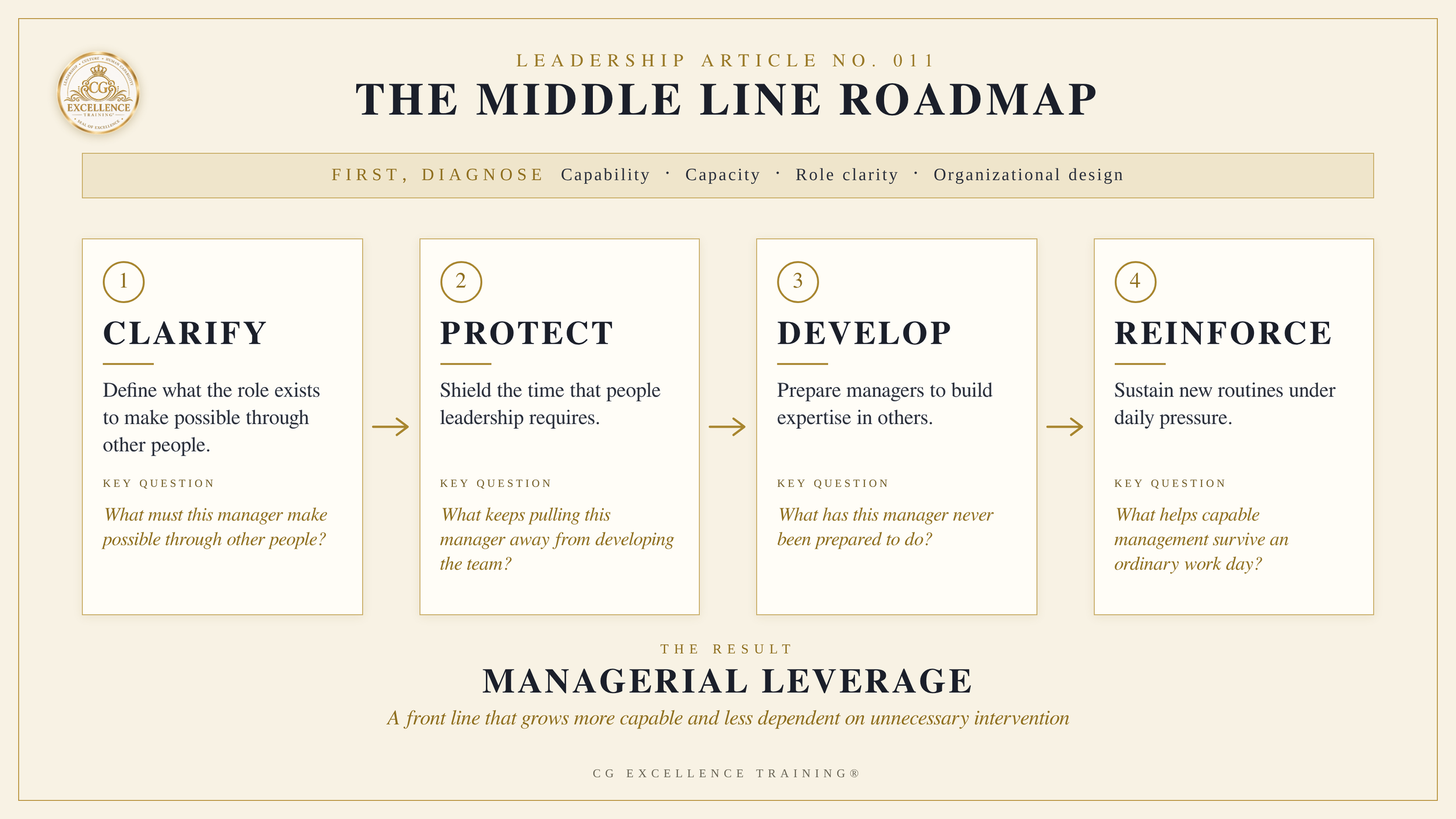
CLARIFY, PROTECT, DEVELOP, REINFORCE
CLARIFY
Define what each manager exists to make possible through other people. Spell out the operational work the role keeps, the decisions employees own, the issues that rise higher and the priority order when demands collide.
Key question: What must this manager make possible through other people?
PROTECT
Examine what repeatedly displaces the work only a manager can do: direct production, routine approvals, meetings, reports, coverage gaps and conflicting priorities from several departments. Decide what to keep, simplify, automate, reassign or remove. Some administration deserves a manager's judgment. Some stays on the desk through habit alone, and leadership can tell the difference.
A coaching block on the calendar is a commitment. Tuesday has a way of testing resolve.
When a better process or tool returns hours to managers, name the work those hours are for. Time saved becomes leadership capacity only when the organization protects what happens next. Hours left unassigned drift back to the nearest urgent task.
Key question: What keeps pulling this manager away from developing the team?
DEVELOP
Dana earned the promotion honestly. Deep knowledge of the operation, steady handling of difficult customers and calm through the busiest shifts made the decision easy. Dana's first schedule was flawless. Dana's first corrective conversation was not.
Dana recognized excellent work on sight. No one had asked Dana to explain the standard aloud, spot a shortfall in a colleague's work or help an employee close the distance.
Promoting expertise is not the same as preparing someone to develop expertise in others. Preparation covers coaching, delegation, useful feedback, conflict, performance judgment and the translation of change, including the human side of new technology. Practice works best on real situations from the manager's own operation.
Key question: What has this manager never been prepared to do?
REINFORCE
A course opens the door. Daily pressure tests whether the lessons hold. Managers need observation and feedback from their own leaders, peers who solve real problems together, and protection for new routines before the next call-off arrives. Each month, review repeated escalations to learn whether each points to a capability gap, unclear authority, missing information or a system failure.
Key question: What helps capable management survive an ordinary workday?
A well-designed manager role should leave evidence behind in the capability of the team.
The Real Measure: Managerial Leverage
Does the manager's work leave the front line more capable, more confident and better able to operate without unnecessary intervention?
That question defines managerial leverage. Evidence appears in ordinary places. Employees develop sharper judgment. Recurring questions decline. Appropriate decisions stay with the front line. Coaching arrives before problems become corrections.
A manager who personally resolves every difficult issue may be skilled, committed and productive. The deeper test asks whether the team grows more capable because that manager is present. Leaders can watch the share of planned coaching sessions completed, the count of preventable escalations and what stops when the manager is absent.
Balance keeps the argument honest. Wider spans can work. Hands-on involvement builds credibility. More coaching is not automatically better, because excessive intervention weakens judgment and teaches employees to seek approval. Managers also remain accountable: a constrained role can explain weak management without excusing avoidance or poor conduct.
The organization owns the design and support of the managerial role. The manager owns the quality of leadership exercised within the role.
Three Executive Takeaways
Diagnose the managerial job before diagnosing the manager. When coaching, communication or employee development is weak, determine whether the manager lacks skill, lacks room to practice or works inside an unclear role.
Protect attention for the people development only managers can deliver. Employee confidence and judgment do not grow from whatever time remains after administration. When leadership work matters, the organization decides what to shield from displacement.
Continue the investment after promotion. A leadership course prepares a manager to begin. Observation, feedback, practical support and continued review keep development connected to the work.
Who Designed the Manager’s Role?
Three questions for the next leadership meeting:
What are our frontline managers expected to make possible, and has the job been designed around that expectation?
Which problems reaching managers require managerial judgment, and which reveal something the organization should clarify, simplify or repair?
If each manager received four hours back next week, what higher-value leadership work would we expect, support and protect?
Beneath all three sits one question of ownership: who has designed the job surrounding the manager? Managers own the leadership exercised inside the role. Executives own the role. When the two ownerships line up, Tuesday keeps the coaching conversation, and Tyler learns the return process from Renee.
From Insight to Action: The Interactive Workbook
Not sure whether you have a manager problem or a manager-job problem? Start with the Manager-Problem Diagnostic.
The MIDDLE LINE | Investing in Your Frontline Managers Interactive Workbook gives your leadership team structured tools to examine the conditions behind manager capability, capacity and role design in your own organization. The workbook helps leaders distinguish skill, capacity, role clarity, decision rights and design before choosing an intervention.
Manager-Problem Diagnostic: sorts a recurring pattern into a capability, capacity, role clarity or design problem
Manager Role Charter: defines what the role exists to make possible
Decision-Rights Review: separates decisions managers own, decisions employees own and decisions that rise higher
Manager Capacity Audit: records one representative week of leading, processing, producing and correcting
Promotion-to-Management Readiness Check: names what a new manager must understand and practice before leading people
The workbook also includes the Frontline Coaching Rhythm and the 30/60/90-Day Middle Line Plan.
A 90-minute path through the workbook shows where to begin.
Ready to find out what kind of manager problem you actually have? Explore the MIDDLE LINE Interactive Workbook and begin with the Manager-Problem Diagnostic.
Select the edition that fits:
The workbook works best in desktop Adobe Acrobat, where scoring and summary pages calculate automatically.
Why This Matters to Me
What I notice on the front line is how quickly employees learn what a manager truly expects. Which decisions are trusted. Which questions need permission. What happens after a mistake. What gets reinforced and what gets left alone.
Managers teach them through small everyday signals: a quick approval, a skipped check-in, a pause before answering. Because managers stand that close to the front line, the job surrounding the manager matters to me. A manager can signal trust, clarity and care only when the role leaves room for all three.
CG Excellence Training exists to help managers lead credibly in both directions: with the front line and with senior leadership. The same belief shapes the workbooks. Managers need tools, support and development that match what the organization expects of the role.
Next in the Series
Leadership Article No. 012 | TOP LINE
FIRST IN LINE examined what organizations invest in the front line. MIDDLE LINE examines the managers responsible for developing frontline professionals. Next, TOP LINE moves to the leaders who set priorities, allocate resources and decide what the organization will protect.
Work With CG Excellence Training
CG Excellence Training creates customized recorded training resources customized for workforce and the manager development needs of each organization. Contact us and begin a conversation about performance development
Thank you for investing in the frontline that supports your bottom line.
About the Author
Christine George is the founder of CG Excellence Training®, a leadership development, workplace culture and customer engagement training company. As an author, speaker and training content creator, Christine George helps organizations strengthen performance on the front line, manager capability and customer engagement.
Research Note
The Gallup finding above comes from Gallup's January 13, 2026 study of U.S. managers on individual-contributor work and span of control. Background reading includes the American Management Association's 2026 research on first-time managers and managerial engagement (July 14 and September 17, 2026), the CIPD Good Work Index 2026 (August 2026), McKinsey's HR Monitor 2026 (June 8, 2026), Dayforce research conducted by Hanover Research (May 21, 2026) and Charter's AI Pulse research (October 21, 2026). The scenes featuring Renee, Tyler, Jordan and Dana are illustrative composites rather than accounts of identifiable individuals or organizations.
© 2026 Christine George LLC | CG Excellence Training®. All rights reserved.