Executive Summary: An approved strategy leaves the meeting room as one decision and reaches the front line as a dozen. Departments launch separate initiatives in the same quarter, and frontline managers become the only people positioned to reconcile the demands. Strategic carryability asks whether a company holds the clarity, resources, authority, and working hours to deliver every commitment while daily work continues. Executives can test carryability in four steps: CHOOSE what matters now, ALIGN competing expectations, RESOURCE what execution requires, and PROTECT the commitment after launch. The result is an enterprise view where strategy and daily performance reinforce each other, and the front line receives direction worth following.
The Meeting After the Meeting
The executive meeting ends right on time.
A new strategic initiative has been signed off. The objectives are clear, the timeline is set, and every department knows the assignment.
As papers get gathered, two senior leaders linger near the door.
One asks whether the new initiative outranks an existing commitment. The other has been turning over the same concern.
The question of rank is left standing at the door.
By afternoon, both leaders are back with separate teams, each holding a slightly different reading of the same announcement.
The initiative moves forward.
So do the doubts.
Here is where strategic decisions begin to reveal how far a single approval can reach. What looks settled in the boardroom may call for a second round of judgment calls across the company. Some will be made by people with authority to resolve competing goals. Others will be made by managers and employees working with whatever time, resources, and information happen to be within reach.
Every decision made at the top eventually lands in somebody's working day.
Strategic Intention to Operating Reality
Senior executives set direction. Opportunities get spotted, risks weighed, goals ranked, and funding assigned at the executive level. Such work calls for judgment, usually amid conflicting interests and incomplete information.
A sound plan can still struggle in practice. Consider a quarter when four departments each launch something new. Operations announces an improvement program. Human Resources introduces a development requirement. Technology schedules a system rollout. Finance adds a reporting process.
Every project has merit. All draw on time and attention from people already keeping the business running day to day.
Eventually the separate requests land on one manager's desk. Has anybody added up the total?
The Top Line owns the question: the executive level where ambitions collide, resources are committed, and decisions set the conditions for everyone's work.
What the Numbers Say
A 2026 Deloitte study of 1,000 change leaders, just over half in the C-suite, across four countries uncovers a similar gap. 84% said employees were expected to handle transformation work on top of existing duties. 54% said nobody in the organization held authority to slow or pause an initiative based on how much change employees could absorb.
The figures capture leader perception, and measured results would add further detail. A fair question stands either way. When several initiatives draw on the same team, who is accountable for the combined demand?
The Fourth Priority
Consider a company with three commitments already underway: stronger customer relationships, a new technology platform, and tighter regulatory compliance.
Then a fourth arrives. Operating efficiency needs attention. The proposal is compelling, and approval follows.
Over the next few weeks, departments translate the approval into assignments, and each performs the work as written.
At a regional service center, a frontline manager receives the rollout schedule alongside the existing performance expectations. Staff must attend training, learn a revised process, and keep meeting service targets.
The manager rearranges the week. A team meeting shrinks. Coaching conversations move to next week.
Then an employee asks a fair question. Does the revised customer procedure outrank the response-time target?
The manager checks the memo from headquarters. Both expectations remain in force.
So the team improvises. A few employees follow the new procedure closely. Others protect the response-time number. Everyone is working hard, and nobody can be sure which choice leadership prefers.
From the executive floor, the initiative looks on schedule. On the service floor, employees are reconciling decisions written in separate departments.
The difficulty reaches beyond the fourth priority.
Four commitments are underway, and no shared decision describes how the group fits together.
Strategic Carryability
Strategic carryability is a plain idea: the room a company has left after existing duties. A new commitment either fits within the remaining space or crowds out existing work. The conversation widens from how important an initiative is to which conditions make delivery possible.
Every company already serves customers, develops employees, meets obligations, and maintains systems. Executives decide where added work will land. Duties could move to other teams. Technology might absorb a current demand. A project may wait for next quarter. Reinforcements can arrive, or an older routine is retired. Each answer is a strategic decision worth making on purpose.
A commitment becomes real when something else moves.
Four Disciplines of Strategic Decision-Making
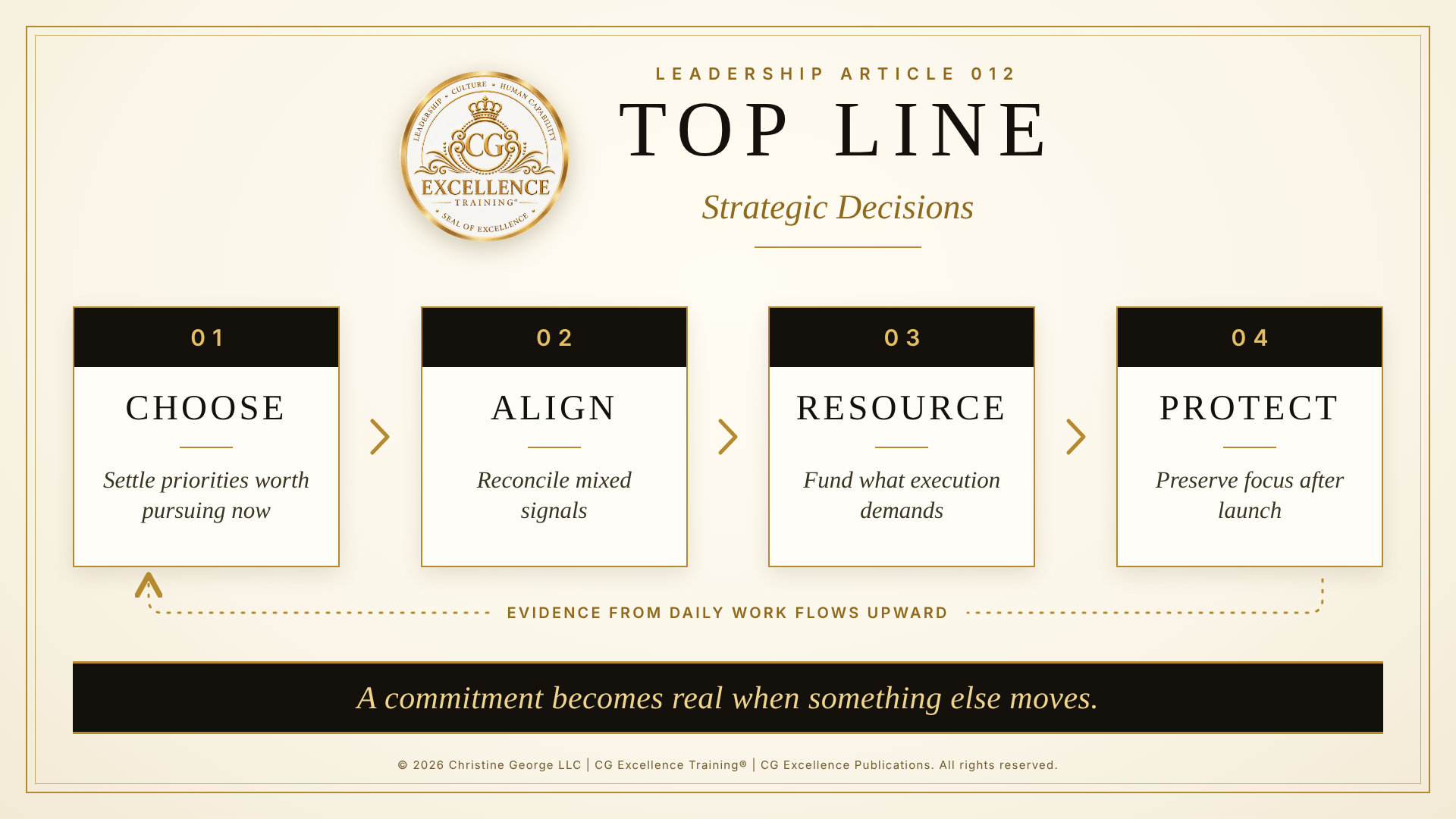
CHOOSE → ALIGN → RESOURCE → PROTECT
Four disciplines offer a practical test of whether commitments can be delivered from the executive floor to the service desk.
CHOOSE | Establish What Matters Now
Choosing separates worthwhile opportunities from commitments a company can responsibly pursue. Senior executives meet more opportunities than any team can deliver at once. Each proposal has an advocate, and many hold real strategic value.
The task is deciding which commitments need attention now, which can follow in sequence, and which should step aside. Before approving another initiative, executives can ask:
What has to change in current commitments to make way for the new one?
ALIGN | Reconcile Mixed Signals
Alignment goes past announcing a shared goal. Executives examine what each department is asking of employees and confirm the direction is consistent.
Consider a company urging employees to invest time in understanding customers while grading performance almost entirely on transaction speed. Employees see the value in stronger relationships. The performance review signals which behavior earns attention.
The measures become part of the message. Executive teams can study how goals, incentives, performance expectations, and decision rights interact once all four reach daily operations.
RESOURCE | Commit What Execution Requires
Budgets signal commitment. So do staffing, schedules, access to information, and management attention.
Consider a technology rollout. The software is purchased. Licenses are distributed. Employees finish training. Yet the old reporting process stays in place, so staff keep two systems running. The investment added a new capability and preserved the work the software was meant to replace.
A fuller resource decision weighs implementation time, workflow integration, continuing support, and routines ready to be set aside. Executives should be able to name which resources moved the day approval came.
PROTECT | Sustain the Commitment and Review Reality
Commitments need attention after launch. Protecting one means preserving the time and focus execution requires while responding to evidence from daily work.
A thirty-day check may reveal extra manager interruptions or duplicate effort. By day sixty, conflicting departmental requirements often surface. At ninety days, executives can see whether the initiative improved the work, added demand, or needs redesign.
Each checkpoint is a chance to adjust the original decision with better information. The purpose is keeping strategy connected to reality as conditions change.
When Information Flows Upward
Strategic decisions move downward. Evidence about the results needs a route back up.
Frontline professionals meet the practical consequences first. Clashing instructions, slower steps, and customer interruptions appear at the service desk long before a report arrives.
Managers see the combined effect: tasks needing extra hands, coaching time displaced, and homemade adjustments the team invented to finish the work. Such observations are operating intelligence of real value.
Executives can build a structured route through implementation reviews, cross-functional conversations, live demonstrations by employees, and a close look at recurring workarounds.
What happens next decides the value. A concern from daily work may call for a ruling on timing, staffing, performance measures, or project scope. Final answers belong with people holding the authority to settle the matter.
Managers translate strategy. Executives decide where goals collide.
Takeaways for the Executive Team
Before the next approval, four moves keep strategy and daily work in step.
Count the load. Before approving another initiative, add up everything the company already expects employees to handle.
Name the trade. Each approval comes with a record of what moved: time, staff, a process, or a deadline.
Assign decision authority. One executive owns the answer when departments disagree, so frontline managers no longer face the conflict alone.
Listen on a schedule. Standing check-ins bring evidence from daily work to people able to act.
Who is responsible for the combined demand on the front line, and has the Top Line made the work possible?
Strategic Decisions In Practice
The TOP LINE | Strategic Decisions Interactive Workbook equips your leadership team with structured tools to examine the conditions behind strategic decisions in your own organization.
Priority-to-Execution Diagnostic: follows one executive goal from approval to daily operations.
Commitment Inventory: lists every initiative now drawing on shared teams.
Conflict Finder: spots contradictory expectations issued by separate departments.
Trade-Off Ledger: records what gave way when a new project launched.
Authority Map: names who may slow, pause, or resequence work.
Resource Tracker: compares budget, staffing, and timelines against actual requirements.
Review Calendar: sets thirty-, sixty-, and ninety-day checkpoints.
A 90-minute path through the workbook points to where to begin.
Select the edition that fits:
The workbook works best in desktop Adobe Acrobat, where scoring and summary pages calculate automatically.
Why This Matters to Me
I have spent years watching what happens when plans made in one room land in another.
Consider the frontline professional following a new process while still graded on yesterday's target. Or the manager who champions a development program and spends the scheduled coaching hour untangling a system outage. Scenes like these hold my attention because every one reveals how leadership choices are truly experienced.
An approval can be entirely sensible when judged alone. The full weight arrives once everything else on the same calendar comes into view. Time spent reconciling instructions is time unavailable for conversation, and an hour lost to a system outage is an hour coaching never receives.
Here is what I have observed along the front line. An engaged, mission-driven employee and a disengaged colleague can work side by side, and the customer feels the difference within minutes. Engagement grows when leaders invest in people and bring out the brilliance already within each person. Daily direction pulling two ways works against growth.
People closest to the customer feel the combined effect of decisions reached upstairs, and their experience points to conditions executives can improve. Hearing them out teaches me how a company truly operates. I invite you to do the same.
Next in the Series
Leadership Article No. 013 | Bottom Line
Strategic decisions reach daily operations, and daily operations reach the Bottom Line. Article 013 follows the trail to results and asks what leadership choices finally contribute there.
Get the next Leadership Article in your inbox. Join CG Excellence Training® Weekly Inspiration.
Work With CG Excellence Training®
CG Excellence Training® develops customized recorded training resources, manager development programs, and tools built around the workforce needs of your organization. Begin a conversation about performance development.
Thank you for investing in the frontline that supports your bottom line.
About the Author
Christine George founded CG Excellence Training®, a leadership development, workplace culture, and customer engagement training company. Author, speaker, and creator of training content, the founder writes the CG Leadership Articles and builds interactive workbooks and recorded training resources supporting managers and frontline professionals.
Research Notes
Survey figures come from the Deloitte and Workplace Intelligence 2026 change management study: The 4:1 change management return most organizations are leaving on the table, Deloitte Insights, October 19, 2026, and the companion release, Deloitte Study Finds Every $1 Spent on Change Management Could Result in 4x Return, October 20, 2026. The survey reached 1,000 change leaders, 51% in the C-suite, across the United States, United Kingdom, Australia, and Canada, fielded in June and July 2026. Findings rest on leader responses rather than measured operating results.
The opening meeting and the Fourth Priority scene are illustrative composites rather than accounts of specific identified organizations. Strategic carryability is a proposed CG Excellence executive concept informed by the research, and no validated measurement scale yet exists for the concept.
© 2026 Christine George LLC | CG Excellence Training® | CG Excellence Publications. All rights reserved.