The Reciprocity of Organizational Intelligence
Executive Summary: Service runs in every direction inside a business. Customers count on the front line, frontline teams look to managers for direction, and executives answer for the whole enterprise.
The harder question follows. Who looks after the people doing the serving?
Article 014 joins the four perspectives of the Line series in one model, the Business Prism, with Organizational Intelligence at the center. The article follows one long afternoon at a service organization, asks what a patient piece of software can teach about human patience, and closes with three moves for decision makers ready to match support to the service expected.
One Long Afternoon
At 4:40 on a Thursday, a customer service representative answers the ninth upset call of the day. A billing change went out that morning, and the caller wants to know why the total jumped.
The representative explains the change. The caller asks again in different words. The representative explains a second time, slower, and then a third. The call ends with a thank-you.
Between calls, the representative sends the supervisor a message: Can we talk for five minutes before I leave?
The supervisor reads the note during a meeting and types back, "Tomorrow, I promise." The supervisor's afternoon has gone to covering two breaks, sitting beside a new hire, and answering the regional director, who wants to know why call times went up.
That evening, the regional director opens the weekly report. Customer satisfaction slipped. The report lists the score and says nothing about the billing change, the nine calls or the five-minute conversation still waiting.
Each of the three spent the day serving someone. None of the three was asked what tomorrow would require.
Later that night, still curious, the representative typed a question about the new billing rule into an AI assistant at home. The question went in four different ways. Each answer came back a little clearer. The software never sighed.
Every person asked to serve deserves an organization willing to serve in return.
How do we serve the servant leaders?
The phrase servant leadership usually describes one person's habits: listening first, putting the growth of others ahead of personal credit, owning the outcome for the team. Good habits matter. Good habits also wear thin when the calendar has no room left and the reporting lines filter out bad news.
Everyone Serves Someone
Service is an exchange between two people, and the person on the receiving end remembers how the attention felt. A customer can tell within seconds whether the representative is listening. An employee notices whether a supervisor looks up from the screen during a question. Executives feel the difference too, in meetings where people speak plainly and in meetings where everyone edits the news first.
Each role spends the day offering patience, judgment and encouragement to someone else. The representative calm with a ninth caller may have little patience left by five o'clock. A supervisor who spends the week cheering on new hires can go the same week without one kind word. An executive responsible for hundreds of jobs may have nobody asking how the weight of those decisions feels.
The person who refills every cup still gets thirsty.
Reciprocity starts with seeing the person inside the role.
What People Notice Before Reports Do
Go back to the ninth call. The words described a billing problem. The tone described worry about a household budget. A skilled representative heard both and answered both. Experience supplied the facts, emotional intelligence caught the worry, and judgment chose the words.
Exchanges like the ninth call happen all day across an organization, and much of what the business needs to know lives inside those conversations.
A representative hears the same new complaint five times before any trend line moves. A supervisor can sense a team wearing down long before the first resignation letter. Reports confirm, weeks later, what people noticed first.
The management job is to build a route for those observations to reach decision makers, and to treat each observation as intelligence worth reading.
What a Patient Machine Can Teach
An unexpected lesson about service comes from working with artificial intelligence.
Think about the representative at home that night. The fourth version of the question received the same attention as the first. Nobody hurried the conversation. The assistant was available at nine o'clock and willing to start over, one step at a time.
Ask a colleague a fourth question, and the reaction often feels different. A request for clarification can land as an interruption. New employees learn fast which questions are welcome and which ones cost something.
What would change if a second question were treated as care for the work? How would a new hire grow if every request for clarification met full attention?
The comparison has limits. A machine can produce a patient reply at any hour. A person at the end of a long shift knows what patience costs and offers patience anyway, and a manager who makes a call answers for the consequences in a way no software can.
Artificial intelligence can expand what an organization is able to do. Human intelligence decides what the work means and who answers for the outcome.
The Business Prism
A prism takes one beam of light and splits the beam into colors. The Business Prism, introduced by CG Excellence Training®, works in reverse. Four perspectives enter, and one shared understanding forms at the center.
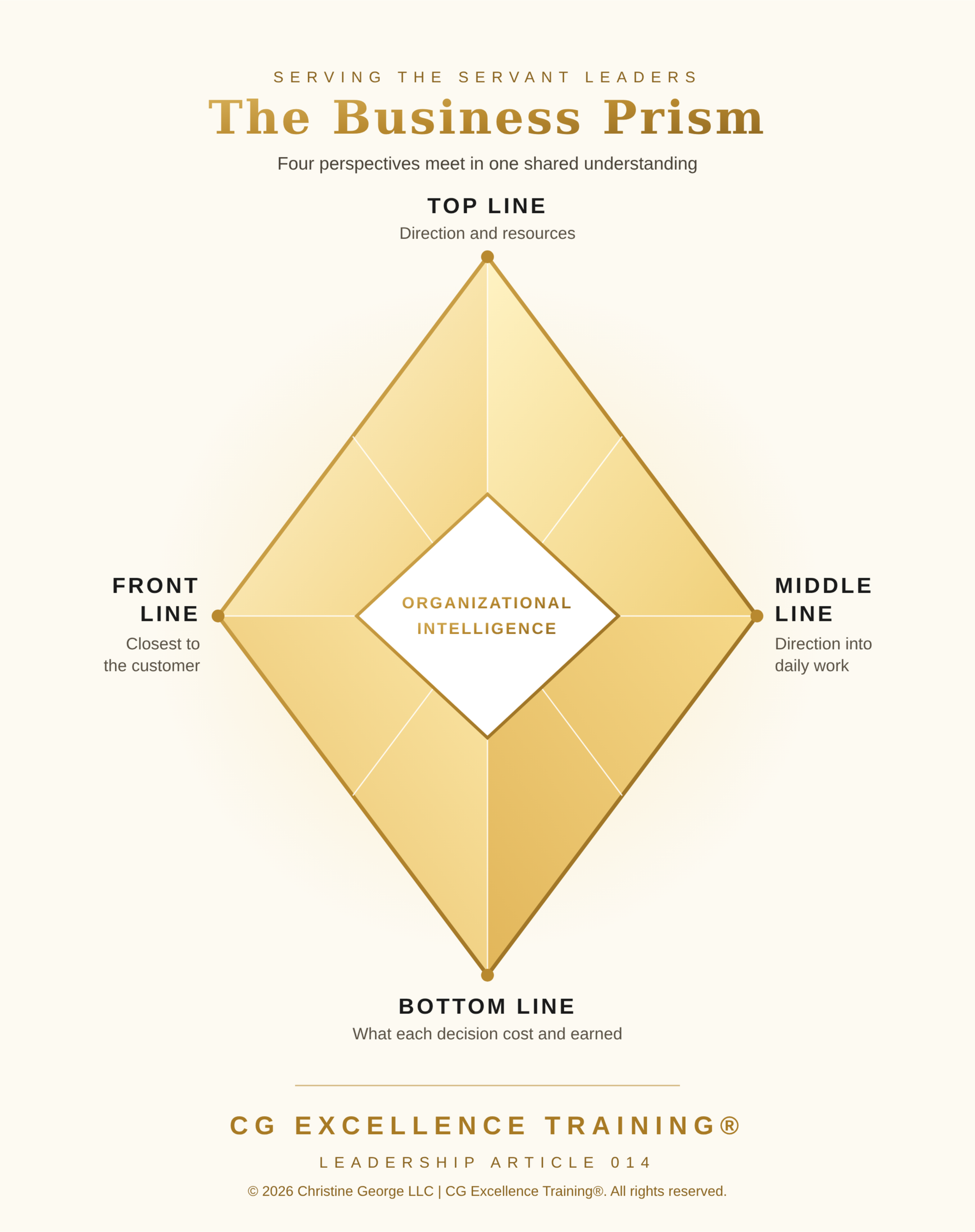
The center is Organizational Intelligence: what the enterprise knows when frontline experience, manager insight, executive judgment, financial results and the analytical reach of AI inform one another.
Trace the billing change through the prism. The representative heard the confusion first. The supervisor was in a position to connect the calls to rising call times. The regional director had the authority to request a clearer customer notice. The satisfaction score recorded the price of the missing connection.
The movement is a loop. A decision changes the working day, the working day changes how customers are treated, and the results feed the next decision.
No single point of the prism sees the whole enterprise.
Support Must Match the Expectation
Consider three people who want to serve well. A manager committed to developing people has no coaching time on the schedule. A representative asked to delight customers works under a policy that blocks the fix for a recurring complaint. An executive committed to a people-first culture receives reports softened at every layer on the way up.
The desire to serve is present in all three roles. The conditions decide how far the desire can go.
Reciprocity means checking each expectation against the support behind the expectation:
Expect judgment from employees, and provide the information and decision authority judgment requires.
Expect managers to develop people, and protect the hours, training and backing development takes.
Expect executives to decide well, and build honest channels for news from the front line to travel upward.
The responsibility runs in every direction. The enterprise grows stronger through the quality of the relationships between roles.
From Heard to Valued
Hearing someone and valuing what the person offered are two different acts.
Suppose the representative finally gets the five minutes and describes the billing confusion. The supervisor sees the pattern and raises the issue. Senior management weighs the request against cost and other priorities. The answer might be a new customer notice. The answer might also be no.
Either answer can build trust when someone explains the reasoning and thanks the person who spoke up. Silence teaches the opposite lesson, and the next observation never arrives.
An organization that listens receives intelligence. An organization that responds turns intelligence into capability.
Back to Thursday
Replay the afternoon with reciprocity built in.
The representative's message reaches a supervisor who keeps a protected half hour each day for conversations with the team. The supervisor flags the billing calls to the regional director the same evening. The regional director reads the satisfaction report with the reason attached and asks the billing team for a plainer customer notice.
The next Thursday, the ninth call never comes.
The same three people did the same jobs. The difference was a route for what each one knew, and a response waiting at the other end.
Three Executive Takeaways
1. Treat service as a shared responsibility. Every level of the organization includes people accountable for someone else's experience. Check whether the support available matches the service expected.
2. Connect the four perspectives. Organizational Intelligence forms when frontline experience, manager knowledge, executive judgment and business results inform one another.
3. Let decisions prove the commitment. Information, authority, resources, development and the speed of a response reveal more about support than any value statement on a wall.
The Question Worth Asking
Recall the last time a frontline employee raised a concern. Follow the concern through the prism and find where the trail stopped. Then ask:
Who in your organization is responsible for serving the people who serve everyone else?
When the answer is everyone, the answer is usually nobody. Name an owner, and support becomes a practice.
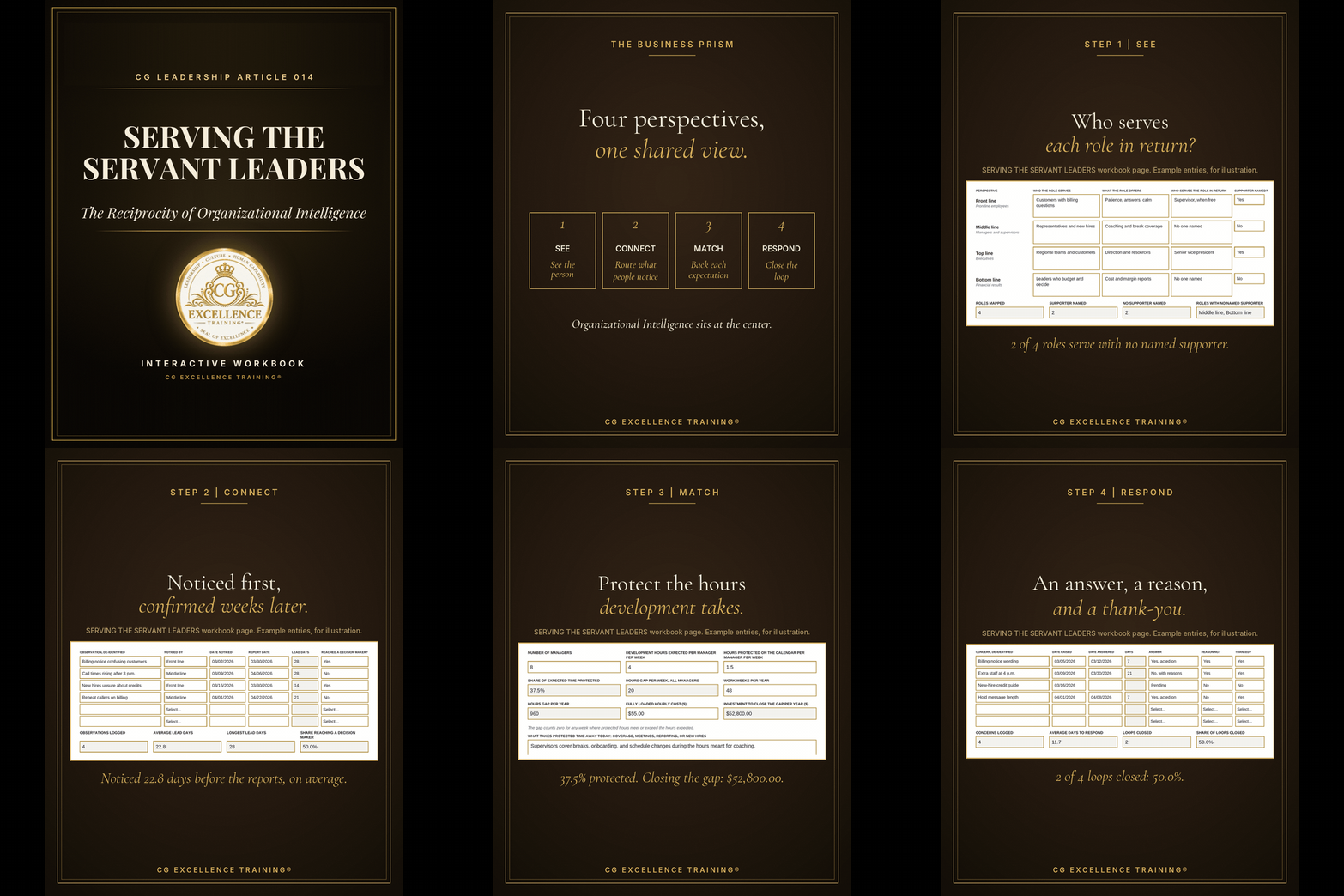
Preview SERVING THE SERVANT LEADERS | The Reciprocity of Organizational Intelligence Workbook
Turn Insight Into Organizational Capability
The SERVING THE SERVANT LEADERS Interactive Workbook turns the Business Prism into a working review: one real frontline concern, followed through four perspectives, with the support behind every role matched to the service expected.
Seven workbook tools:
Role Service Map: who each role serves, and who serves each role in return.
Observation Log: the days between what people notice and what reports confirm.
Organizational Intelligence Route Map: the route each perspective, including AI analysis, travels to the people who decide.
Support-to-Expectation Check: every expectation rated against the support in place.
Protected Time Calculator: development hours expected of managers compared with the hours protected on the calendar.
Response Loop Tracker: days to respond, reasoning explained, and thanks given for every concern raised.
Business Prism Assessment: eight conditions across See, Connect, Match and Respond, scored out of 40.
The 90-minute path
Begin with the Two-Minute Reciprocity Check, choose one concern, map the roles, log what people noticed, check support against expectations, track the response loop, complete the assessment, and finish with the Executive Summary and Decision.
Editions
Individual License | 10-Participant Team License | 25-Participant Organization License
Download your workbook
Continue Exploring CG Excellence
FIRST IN LINE | Investing in Your Frontline, on the people who meet the customer every day.
MIDDLE LINE | Investing in Your Frontline Managers, on the managers who turn direction into daily work.
TOP LINE | Strategic Decisions, on the disciplines behind strategy at the top.
BOTTOM LINE | Decisions Behind the Numbers, on the financial and human consequences of organizational decisions.
The Value of Human Capital, on recognizing what people make possible.
Why This Matters to Me
After four articles on four lines, I kept returning to the people inside each line, every one of whom spends the workday serving someone else. Looking through the Business Prism, one question stayed with me: how do we serve the servant leaders?
Working with artificial intelligence sharpened the question. Over many conversations, I noticed how much patience, availability and a willingness to go one step at a time meant to me as the person asking. The experience made me wonder how our workplaces would feel if every employee received the same patience when asking a second or third question.
I believe serving others is a calling worth honoring. I also believe people who devote a career to serving others deserve support, understanding and respect at work.
The capacity to serve grows through the experience of being served.
An organization committed to service extends the same care inward that the organization promises outward. Who serves the servant leaders? The answer belongs to all of us.
Next in the Series
Leadership Article No. 015, THE EXPERIENCE OF MATTERING | The Human Need at the Heart of Workplace Culture, moves from support to significance. What does an employee need to know, every day, to feel the contribution counts?
Work With CG Excellence Training
True results start with managers who view the organization as a whole. CG Excellence Training offers customized recorded training resources built around organizational priorities, manager development and workforce needs. Each resource is created for one organization alone and is never shared. Your team learns privately, on their own schedule, in any time zone, inside the culture unique to your organization. Contact us to begin a conversation about performance development for you and your team.
Thank you for investing in your frontline that supports your bottom line.
About the Author
Christine George is the founder of CG Excellence Training® and develops leadership frameworks, recorded training resources, and implementation tools focused on workplace culture, customer experience, employee capability, and enterprise performance.
Research Notes
The service organization, customer service representative, supervisor and regional director in the article are illustrative composites built from recognizable workplace situations. No statistics were invented.
The term servant leadership comes from Robert K. Greenleaf's 1970 essay, The Servant as Leader.
The Business Prism framework and the organizational implications represent the editorial analysis of CG Excellence Training®.
© 2026 Christine George LLC | CG Excellence Training®. All rights reserved.