Decisions Behind the Numbers
The financial and human consequences of organizational decisions.
Executive Summary: The dashboard glowed green. The front line felt the strain. Every executive has celebrated a strong quarter, and few stop to ask what the quarter cost. A saving on paper can come from better work. A saving can also come from work slipped onto a customer, a manager or a colleague with no room left on the calendar. This article follows a CEO, an HR director and a business owner as each one looks behind a strong result and finds a different story. The Line series closes with four steps, TRACE, MEASURE, VALUE and REINVEST, for telling a gain that lasts from a cost that has only moved.
A Strong Quarter
Consider a CEO reading the quarterly results.
Revenue hit target. Operating expenses fell. Productivity rose. By every measure on the executive dashboard, the business performed.
The CEO had reason to smile.
Out on the front line, a different story was unfolding. A veteran frontline employee was updating a résumé. Managers were splitting extra duties across schedules already full. Customers were calling twice about problems one conversation used to solve.
Technology had sped up the simple transactions. The people who remained were handling the hard ones: the exceptions, the upset callers, the cases needing judgment.
The financial statement reported the quarter. The people doing the work paid what the quarter cost.
The CEO had one more question to ask. What did the business spend, beyond dollars, to produce these numbers?
The bottom line tells us what the organization achieved financially. The decisions behind the numbers explain how those results were produced and whether the gains can be sustained.
Two Kinds of Savings
Financial results matter. Revenue funds operations, profit funds investment, and cash keeps promises to employees, suppliers and lenders. Every organization, of any size, needs a clear grasp of the economics.
Every result also traces back to choices made across the enterprise.
A drop in operating expense may come from a better process or a well-run technology rollout. The same drop may come from work shifted to another department, duties piled onto the remaining staff, or an investment pushed into next year.
One saving lasts. Another is a bill with a later due date.
Decision makers protect the bottom line by knowing which one sits in the report.
The Cost of Losing Capability
Meanwhile, an HR director is reviewing a resignation from a seasoned employee.
Some costs are easy to count: recruiting, onboarding, training a replacement, overtime while the seat stays empty.
Other costs take longer to surface. Years on the job built judgment. Familiarity with internal systems built speed. Customers asked for the employee by name. Colleagues walked over with questions every day and got answers.
When a person like the departing employee leaves, the organization has to decide how to replace, transfer or spread that knowledge. Until then, the gap turns up as more manager time, longer resolution times and teams that move slower.
A development budget trimmed to make one quarter look better can return as a resignation the next quarter.
Some savings walk out the front door at five o'clock, wearing a name badge.
The HR director asks a better question than the cost of filling a seat. What capability is leaving, and what will restoring the contribution require?
For senior management, the answer provides a fuller basis for decisions about development, manager support and retention. For frontline supervisors, the answer recognizes the economic value of the knowledge frontline teams contribute every day.
The Customer Who Almost Left
Next comes a business owner.
A longtime customer calls with a complaint. The frontline employee on the call understands the problem and sees a chance to keep the relationship.
Keeping the customer requires a decision: a replacement, a credit, an exception or extra time. Each option costs money.
The owner weighs today's expense against the value of a customer who returns, refers friends and buys again next year. Every exception also has operational and financial weight. The goal is a decision that is fair, informed and affordable.
Research published in 2026 in The Service Industries Journal adds a useful distinction. In hotel-service recovery experiments, customers rated a recovery more favorably when invited to take part in identifying the solution. The benefit weakened when customers also had to put the fix in place themselves.
Offer customers a voice, and recovery improves. Hand customers the repair work, and the cost of the failure lands on the customer.
For the frontline employee, a good recovery depends on preparation, information, authority and support. For the manager, the job is to set clear decision limits and coach good judgment inside those limits. For the owner, the money question reaches past the cost of the fix:
What is the relationship worth?
How likely is the remedy to restore confidence?
What condition caused the problem, and what can change?
The customer lives the conversation. The organization lives with the economics. Management connects the two.
Who Is Absorbing the Work, and for How Long?
AI, automation and digital tools can speed service, improve accuracy and widen access. The value depends on how well the tools are implemented and measured.
In November 2026, Gartner reported results from a survey of 275 heads of customer service and support, conducted in July and August 2026. Only 4% said the organization had achieved the return expected from AI initiatives. Twenty-one percent had reduced human-agent headcount because of AI, and 7% had already rehired people after earlier cuts.
The figures are self-reported by the people surveyed, and no auditor checked the math. Still, the gap between projected savings and proven returns deserves a hard look.
An automated system may handle routine requests well. The employees who remain then face a heavier mix of complex issues, exceptions and emotional calls. The job changes, and preparation, coaching, decision authority, workload and targets need to change as well.
Shorter transaction time can be a real gain. Fewer salaries can be a real saving. Neither number tells the full economic story alone. Managers also need to know whether customer needs are met, whether unresolved work moved somewhere else, and whether employees are ready for the work left behind.
One plain question earns a place in every review. Who is absorbing the work, and for how long?
If technology removed steps nobody needed, the organization gained.
If technology moved the work onto customers, managers or remaining staff, the moved work belongs in the performance review.
If technology freed time employees now spend on higher-value work, the organization has a second chance to grow.
Four Lines, One Organization
The Line series has looked at the organization from four positions.
FIRST IN LINE | The frontline
Frontline employees meet the customer directly. Employees see recurring problems, shifting expectations and broken processes first, and that knowledge is operational intelligence.
MIDDLE LINE | Frontline managers
Managers turn direction into daily work. Managers see whether expectations match the time, staff and authority available.
TOP LINE | Senior executives
The C-suite sets direction, assigns resources and protects the conditions for execution through four disciplines: CHOOSE, ALIGN, RESOURCE and PROTECT.
BOTTOM LINE | Results
Financial performance records the economic outcome of every decision above.
Each line knows something the other lines need. The organization runs as one system. The positions differ, and the consequences are shared. Every organization needs a repeatable way to connect a decision with an outcome.
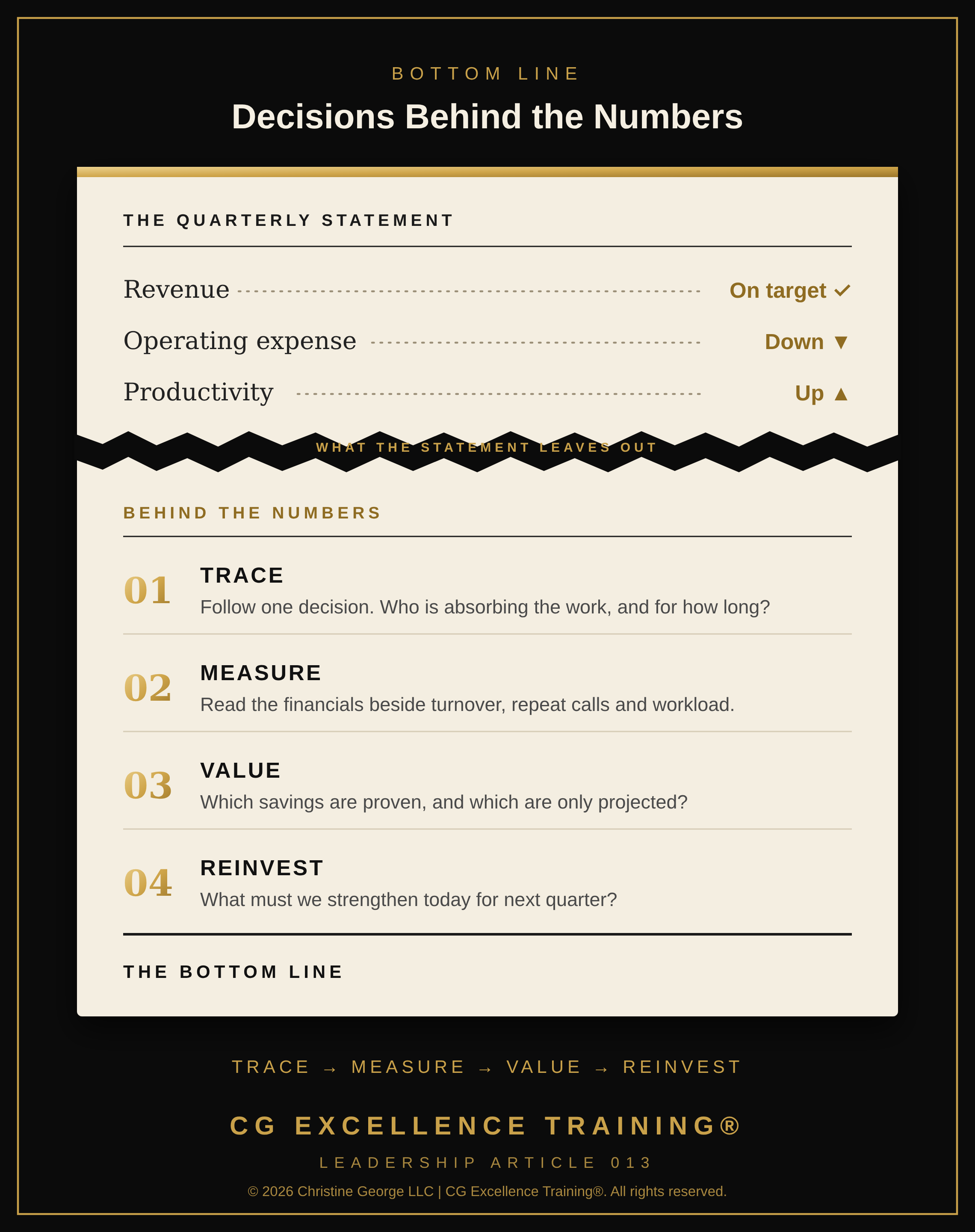
TRACE | Follow the decision
Start with one real choice: a staffing change, a new system, a service policy, a productivity target or a training investment. Follow the choice through the organization.
How did the work change?
Which duties shifted, and to whom?
What changed for managers and employees?
What changed for the customer?
Which financial results followed?
MEASURE | Check the evidence
Read revenue, margin, operating expense and cash flow next to the operating signals: repeat contacts, resolution time, turnover, time to competence, manager workload, recovery outcomes and customer retention. Some measures confirm results already earned. Others warn about results still to come. Keep a clear line between what was measured and what was assumed.
VALUE | Price the consequences
Decide which consequences touch revenue, cost, productivity, risk or future capacity. A process fix may cut labor hours. A good recovery may keep a customer. Development may raise proficiency and reduce dependence on a few veterans. Freed employee time becomes financial value only when the time produces something identifiable: lower expense, more output, better service or lower risk. Count each benefit once.
REINVEST | Sustain the result
Put resources where the evidence points to the next gain: development, process repair, better technology, customer recovery or stronger manager support. Sometimes reinvestment means simplifying work or moving decision authority closer to the customer. The guiding question: What must we strengthen today to deliver the performance we expect tomorrow?
A Different Conversation
Return to the CEO and the quarterly results. The numbers have not changed. The achievement is real.
This time, more voices join the meeting.
The HR director names where critical knowledge sits and which departures would hurt continuity.
Frontline managers raise the recurring customer issues, the workload pressure and the steps worth removing.
The head of technology separates savings already realized from savings still projected, and points out where jobs have changed.
The head of customer experience reports which relationships are growing stronger and which are at risk.
The chief financial officer ties every finding to cost, revenue, investment and risk.
Now the business can keep the real efficiencies, catch hidden costs early and spend with more precision. Performance becomes both a result and a responsibility.
Five Ideas for Your Next Management Meeting
Every number has a backstory. Ask what decisions produced the quarter before celebrating the quarter.
Some savings are deferred bills. Separate lasting gains from costs that moved to another team, a customer or next year.
Capability has a price tag. A departing veteran takes judgment, relationships and speed out the door.
Customers want a voice in recovery. Invite customers to design the fix with you, and keep the repair work inside the organization.
Ask who is absorbing the work, and for how long. Put the question on the agenda after every automation project and every headcount change.
The Question Worth Asking
Pick one decision from the last two quarters that improved a financial result. Trace the decision through all four lines: frontline, managers, senior executives and results. Then ask:
Who in your organization tracks where the cost lands?
When nobody owns the question, the cost surfaces later in turnover, repeat contacts or lost customers. Name the owner, and the whole organization can sustain the bottom line.
Turn Insight Into Organizational Capability
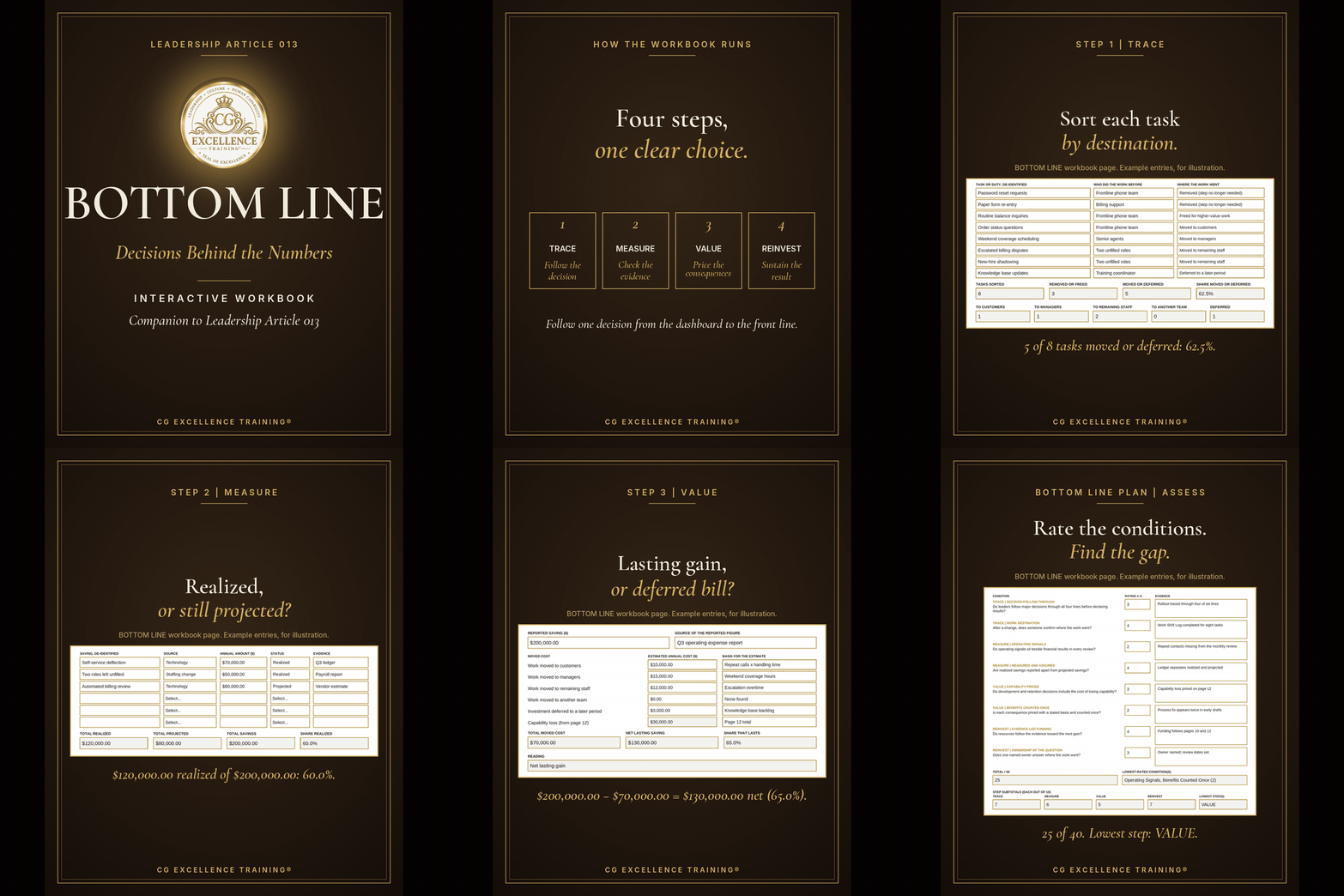
The BOTTOM LINE | Decisions Behind the Numbers Interactive Workbook equips your management team with structured tools to trace decisions to results inside your own organization:
Work Shift Log to sort every task a decision moved and record who picked up each one.
Evidence Dashboard to place turnover, repeat contacts and workload beside the financial results.
Realized or Projected Savings Ledger to separate savings already banked from savings still on paper.
Capability Loss Calculator to estimate what a seasoned employee's departure costs beyond recruiting and onboarding.
Customer Recovery Decision Worksheet to weigh the cost of a remedy against the value of keeping the customer.
Lasting Gain or Deferred Bill to divide each result into gains that last and costs still coming due.
30/60/90-Day Bottom Line Plan to turn findings into commitments, owners and check-in dates.
Short on time? The 90-minute path on page 4 lists eight pages for a complete first review, from the Two-Minute Bottom Line Check to the Executive Summary.
All three editions are on one page. Choose yours at the BOTTOM LINE Workbook:
Individual License for one manager working through the analysis personally
10-Participant Team License for team meetings and department reviews
25-Participant Organization License for manager development across functions
The workbook is designed for desktop Adobe Acrobat, where the scoring and summary pages calculate automatically.
Begin with one decision from last quarter already waiting inside your business.
Continue Exploring CG Excellence
FIRST IN LINE | Investing in Your Frontline, on the people who meet the customer every day.
MIDDLE LINE | Investing in Your Frontline Managers, on the managers who turn direction into daily work.
TOP LINE | Strategic Decisions, on the disciplines behind strategy at the top.
BLIND $POT | Cascading Consequences, on demand that leaves one metric and lands somewhere else in the organization.
The Value of Human Capital, on recognizing what people make possible.
Why This Matters to Me
From what I see on the front line, every financial result starts with an employee deciding how fully to engage. An engaged, mission-driven employee saves the customer who almost left. A disengaged employee lets the same customer go, and the loss never appears as a line item. Engagement grows when organizations invest in people and treat employee experience as capital worth protecting. The Line series is for everyone, from the front line to the boardroom, to see the return on that investment.
Next in the Series
Leadership Article No. 014, SERVING THE SERVANT LEADERS | The Reciprocity of Organizational Intelligence, flips the question. Frontline teams and managers serve customers and colleagues all day. How are your servant leaders supported?
Work With CG Excellence Training
True results start with managers who view the organization as a whole. CG Excellence Training offers customized recorded training resources built around organizational priorities, manager development and workforce needs. Each resource is created for one organization alone and is never shared. Your team learns privately, on their own schedule, in any time zone, inside the culture unique to your organization. Contact us to begin a conversation about performance development for you and your team.
Thank you for investing in your frontline that supports your bottom line.
About the Author
Christine George is the founder of CG Excellence Training® and develops leadership frameworks, recorded training resources, and implementation tools focused on workplace culture, customer experience, employee capability, and enterprise performance.
Research Notes
The CEO, HR director and business owner scenes are illustrative composites built to illustrate recognizable business decisions. No statistics were invented.
Gartner, November 4 and 5, 2026. Survey of 275 heads of customer service and support, conducted July to August 2026: 4% achieved the expected ROI of AI initiatives; 21% reduced human-agent headcount because of AI; 7% rehired after earlier reductions. Gartner newsroom
O'Cass, A., Sharifi, S., Siahtiri, V., and Saniee, A. (2026). Customer participation in service recovery: Accounting for the role of customers' perceived control and empowerment in hotel services. The Service Industries Journal. Taylor & Francis
The TRACE → MEASURE → VALUE → REINVEST framework and the organizational implications represent the editorial analysis of CG Excellence Training®.
© 2026 Christine George LLC | CG Excellence Training®. All rights reserved.