The Human Need at the Heart of Workplace Culture
Executive Summary: Every workplace depends on people. A harder question follows. Does each person know the organization values the human being as well as the output?
Article 015 introduces the Contribution-Significance Gap, the distance between how much an organization relies on someone and how much the person feels valued in return. The article opens with one manager's first morning back at work, looks at what a late birthday card revealed inside a retail chain, and closes with four responses for decision makers: RECOGNIZE, RELATE, ENABLE and PROTECT.
Back on a Monday
At 7:50 on a Monday morning, an operations manager returns after four days away for a family emergency.
The inbox is full. Two customer escalations wait for a call back. Three approvals sit in a queue nobody else had permission to touch. A scheduling problem from Wednesday is still open, because the team decided to wait.
By nine o'clock, four colleagues have stopped by the office door. Each one says a version of the same sentence.
"We couldn't function without you."
The words sound like appreciation. The accumulated responsibilities reveal a deeper organizational concern. A whole department paused for four days until one person came back.
Nobody asked about the family emergency.
Driving home that evening, the manager turns over a question few job descriptions address. Does being indispensable mean being valued?
An organization can need the work without knowing the person who does the work.
Two Questions Inside Every Job
People offer a workplace far more than hours. Expertise, judgment, relationships, emotional energy and years of hard-won knowledge go into the work every day. Over time, many employees become essential to how the organization runs.
Being essential and feeling significant can exist side by side. The two experiences can gradually become disconnected.
Psychologists use the word mattering for the sense of being significant to other people. Workplace researchers have studied the idea closely. A team writing in The Journal of Positive Psychology built and tested an Organizational Mattering Scale across four studies. The work found one general mattering factor with two parts, recognition and achievement. The research identified positive relationships between organizational mattering, job satisfaction and employees' reported intention to remain with an organization.
Recognition notices an achievement. Mattering reaches the person behind the achievement.
A professional can earn an excellent review, win a service award and remain the first call for every difficult assignment, and still have unanswered questions:
Is professional judgment part of the decision?
Are personal goals remembered at review time?
When life changes, does the organization respond?
Does well-being count alongside the targets?
The answers arrive through relationships, decisions and the everyday conditions of work.
The Contribution-Significance Gap
Reliance is normal in any team. Customers rely on service. Operations depend on coordination. Managers turn strategy into daily decisions.
A Contribution-Significance Gap develops when organizational reliance exceeds the consideration experienced by the contributor.
Consider a senior customer care specialist who untangles the hardest complaints. Supervisors praise the specialist's dependability. Colleagues walk over for advice. Every difficult case lands at the same desk.
Meanwhile, the same service failure repeats each month. The specialist's ideas for a permanent fix go unanswered. A training course is postponed twice because the queue cannot spare the time.
The organization enjoys the benefit of the expertise. The specialist feels the weight of being depended upon.
CG Excellence Training® defines the gap as the difference between the value an organization receives from a person's contribution and the significance the person experiences inside the organization.
The gap invites two separate questions.
How much does performance depend on this person's contribution?
How strongly does the person experience respect, influence and consideration in return?
Different evidence answers each question. Operational records reveal organizational dependence. Employee perceptions reveal experienced significance.
Being counted upon and experiencing personal significance are distinct parts of working life.
What a Late Birthday Card Revealed
Culture forms in small moments, such as a remembered conversation or a decision explained to the people affected.
Research from a national retail chain suggests small moments of consideration can influence workplace behavior. Michal Hodor, Liat Eldor and Peter Cappelli examined records from 252 stores where managers were expected to personally deliver a birthday card and a small gift to each employee.
When delivery was delayed beyond the customary period, researchers observed increased absence, including more paid sick time, and reduced working hours. Attendance patterns recovered following delivery. Managers who delivered late reported competing operational priorities.
The study examined delayed recognition rather than perceived mattering. The findings nevertheless raise an important consideration for decision makers: employees may interpret everyday expressions of attention, including missed expectations, as signals of personal significance.
A recognition program can exist on paper and miss the person in practice. A workplace may celebrate achievements every quarter while employees keep wondering whether anyone considers circumstances, judgment and well-being. Mattering grows in the space between what the organization intends and what each person experiences.
When Being Needed Wears a Person Down
The desire to contribute runs deep. People find meaning in supporting colleagues, serving customers and developing others.
Contribution can slowly turn into constant availability. One manager becomes the person behind every difficult decision. An experienced employee becomes the permanent fix for a recurring problem. A trusted colleague absorbs extra duties because everyone has learned the colleague never says no.
Over time, indispensability stops feeling like an honor and starts feeling like an expectation. The organization praises commitment while the professional's capacity becomes increasingly constrained.
A person deserves to feel significant without becoming indispensable.
Sustainable contribution needs more than appreciation. People need resources, decision authority, development, shared responsibility and boundaries that protect well-being. Managers who support others need support in return. Frontline employees need operating conditions that respect service judgment. Executives need relationships where significance reaches beyond the quarterly results.
Four Steps Across the Gap
CG Excellence Training® proposes four connected responsibilities as the response to the Contribution-Significance Gap: RECOGNIZE → RELATE → ENABLE → PROTECT.
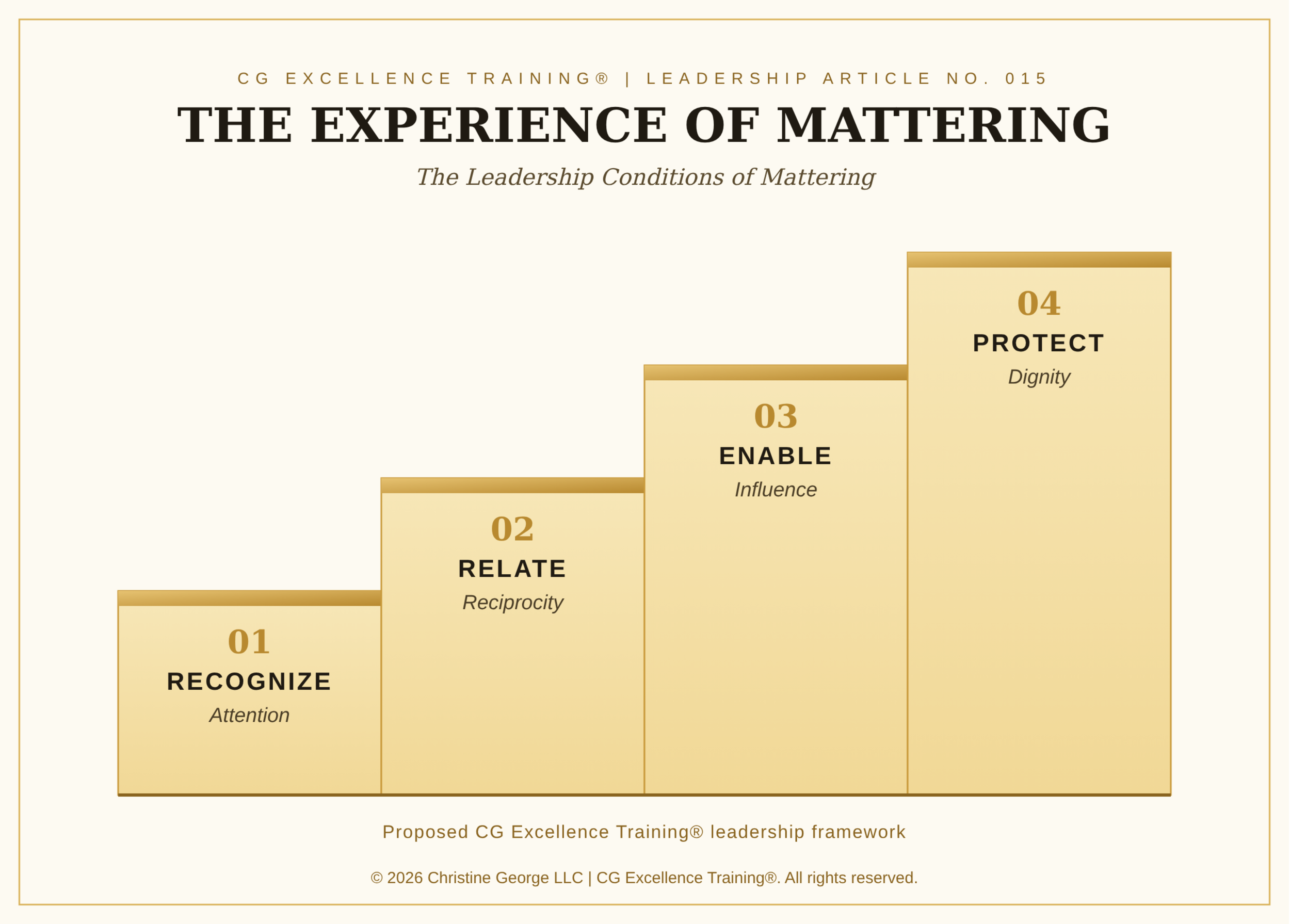
RECOGNIZE | Notice the Person and the Contribution
Attention comes first. Acknowledge the contribution while staying aware of the judgment, circumstances and aspirations of the contributor. Respect individual preferences, since some people welcome a public thank-you and others value a private word. Include work that never appears on a scorecard.
RELATE | Build Two-Way Consideration
Relationships signal significance through follow-through and respect. Return to last week's conversation. Ask about the conditions affecting the work. Make sure the people who serve others also receive real support.
ENABLE | Open Room for Influence
People feel a contribution more fully when knowledge and judgment can change an outcome. Employee voice needs a visible response. Listening invites contribution. A visible organizational response demonstrates meaningful consideration.
PROTECT | Keep Dignity Steady Through Change
Protection is an organizational responsibility. Keep workloads reasonable, share capacity across the team, and plan support for changing circumstances such as illness, caregiving, restructuring and new technology. Decisions made during those seasons tell employees whether consideration extends beyond current productivity. Fair processes, clear boundaries and open communication complete the commitment.
Mattering Across the Business Prism
The need to matter runs through every line of the enterprise.
On the front line, significance comes through respect for service judgment, real customer relationships and a chance to fix recurring problems.
In the middle line, managers need organizational backing, enough authority and room to develop others without becoming the answer to every problem.
At the top line, executives face questions about trusted relationships, shared responsibility and an identity beyond organizational performance.
From the bottom-line perspective, the Contribution-Significance Gap invites examination of workforce commitment, retention, service quality and sustainable organizational performance.
Within the Business Prism, Organizational Intelligence connects the four views. Decisions set operating conditions, conditions affect human experience, and human experience feeds organizational capability. Mattering belongs at the center of the prism.
How to Measure Mattering
Organizations can measure the experience of mattering through employee perceptions and examine the operating conditions associated with that experience. Policies, recognition events and development programs can create those conditions. The employee's perception remains the final test.
Decision makers can examine observable conditions: workload, decision authority, participation, manager responsiveness, development opportunities and the treatment of people during change. Validated employee surveys, such as the Organizational Mattering Scale, add the second view.
A strong engagement score cannot prove mattering. Neither can a large recognition program or a long list of indispensable employees. The defining evidence comes from employees reporting personal experience.
A Different Monday
Replay the operations manager's first morning back with the four steps in place.
Before the leave began, a colleague received authority to approve routine requests. The escalations went to a supervisor ready for the calls. The team settled the scheduling problem on Wednesday.
On Monday, the first visitor at the office door asks one question. "How is your family?"
The workload is lighter, and the message is clearer. The organization still depends on the manager. Now the manager also knows the dependence comes with care.
Three Executive Takeaways
1. Examine the Contribution-Significance Gap. Find where performance depends heavily on people who experience little consideration, influence or support in return.
2. Make contribution sustainable. Match responsibility with resources, decision authority, development, shared capacity and healthy boundaries.
3. Measure the experience and the conditions. Pair employee-reported mattering with observable practices, and assign an owner for improvement and follow-up.
The Question Worth Asking
Consider the person everyone calls when something goes wrong.
The professional who resolves the difficult situation. The manager who absorbs the additional responsibility. The colleague whose experience and judgment have become essential to organizational performance.
When did someone last offer the same person meaningful consideration beyond the work?
Who within your organization accepts responsibility for creating the conditions through which every employee can experience personal significance?
The answer begins with leadership.
Organizational responsibility becomes visible through the decisions, relationships, resources and working conditions that communicate the value of human contribution and the significance of the contributor.
Turn Insight Into Organizational Capability
THE EXPERIENCE OF MATTERING | Interactive Workbook
Translate executive insight into structured organizational examination.
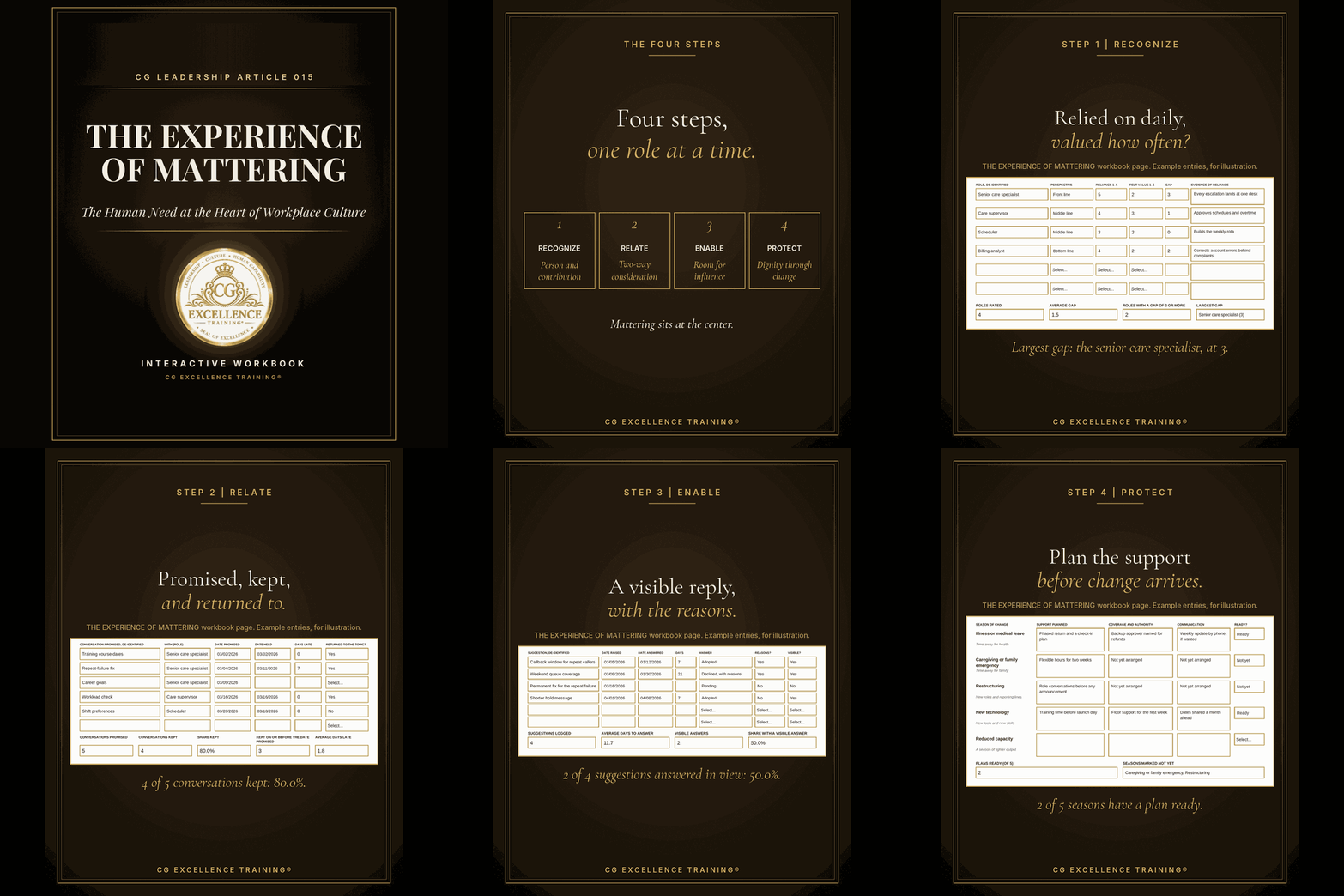
THE EXPERIENCE OF MATTERING | The Human Need at the Heart of Workplace Culture Interactive Workbook equips your management team with structured tools to identify, examine and address the Contribution-Significance Gap inside your own organization:
Contribution-Significance Gap Map to set how heavily the organization relies on each role against how valued the people in each role feel.
Single-Point Dependence Inventory to list the approvals, decisions and fixes that wait for one person.
Recognition Preferences Profile to record how each team member prefers to be thanked, in public or in private.
Follow-Through Log to track the conversations promised and the conversations kept.
Voice-to-Response Tracker to follow each employee suggestion to a visible answer.
Dignity Through Change Plan to prepare support for leave, restructuring and periods of reduced capacity.
30/60/90-Day Mattering Plan to turn findings into owners, commitments and check-in dates.
Short on time? The 90-minute path guides a management team through a complete first review in one working session.
All three editions are on one page. Choose yours at THE EXPERIENCE OF MATTERING Workbook:
Individual License for one manager working through the review personally
10-Participant Team License for team meetings and department reviews
25-Participant Organization License for manager development across functions
The workbook is designed for desktop Adobe Acrobat, where the scoring and summary pages calculate automatically.
Begin with the person your team calls first.
Continue Exploring CG Excellence
FIRST IN LINE | Investing in Your Frontline, on the people who meet the customer every day.
MIDDLE LINE | Investing in Your Frontline Managers, on the managers who turn direction into daily work.
TOP LINE | Strategic Decisions, on the disciplines behind strategy at the top.
BOTTOM LINE | Decisions Behind the Numbers, on the financial and human consequences of organizational decisions.
SERVING THE SERVANT LEADERS | The Reciprocity of Organizational Intelligence, on the support owed to the people who serve everyone else.
Why This Matters to Me
Across the series, one principle keeps returning to me. The people who serve others deserve the same consideration, respect and humanity expected in every customer relationship.
Serving the Servant Leaders asked how support travels inward. Mattering asks a more personal question. Does the person doing the work feel seen?
Professional contribution is meaningful. Human presence is significant. A workplace has the chance to honor both, every day, in decisions large and small.
Many organizations depend on the work of many people. The deeper opportunity is a workplace where every person feels the significance of both presence and contribution, with the dignity every human being deserves.
Work With CG Excellence Training
True results start with managers who view the organization as a whole. CG Excellence Training offers customized recorded training resources built around organizational priorities, manager development and workforce needs. Each resource is created for one organization alone and is never shared. Your team learns privately, on their own schedule, in any time zone, inside the culture unique to your organization. Contact us to begin a conversation about performance development for you and your team.
Thank you for investing in your front line that supports your bottom line.
About the Author
Christine George is the founder of CG Excellence Training® and develops leadership frameworks, recorded training resources, and implementation tools focused on workplace culture, customer experience, employee capability, and enterprise performance.
Research Notes
The operations manager, the customer care specialist and the workplaces in the article are illustrative composites built from recognizable workplace situations.
The birthday card findings come from Michal Hodor, Liat Eldor and Peter Cappelli, "The Lower Boundary of Workplace Mistreatment: Do Small Slights Matter?" Proceedings of the National Academy of Sciences, 2025.
The Organizational Mattering Scale comes from Reece and colleagues, "Mattering Is an Indicator of Organizational Health and Employee Success," The Journal of Positive Psychology, 2021.
The Contribution-Significance Gap, the RECOGNIZE → RELATE → ENABLE → PROTECT framework and the Business Prism application are proposed CG Excellence Training® frameworks and have not undergone independent empirical validation.
© 2026 Christine George LLC | CG Excellence Training®. All rights reserved.